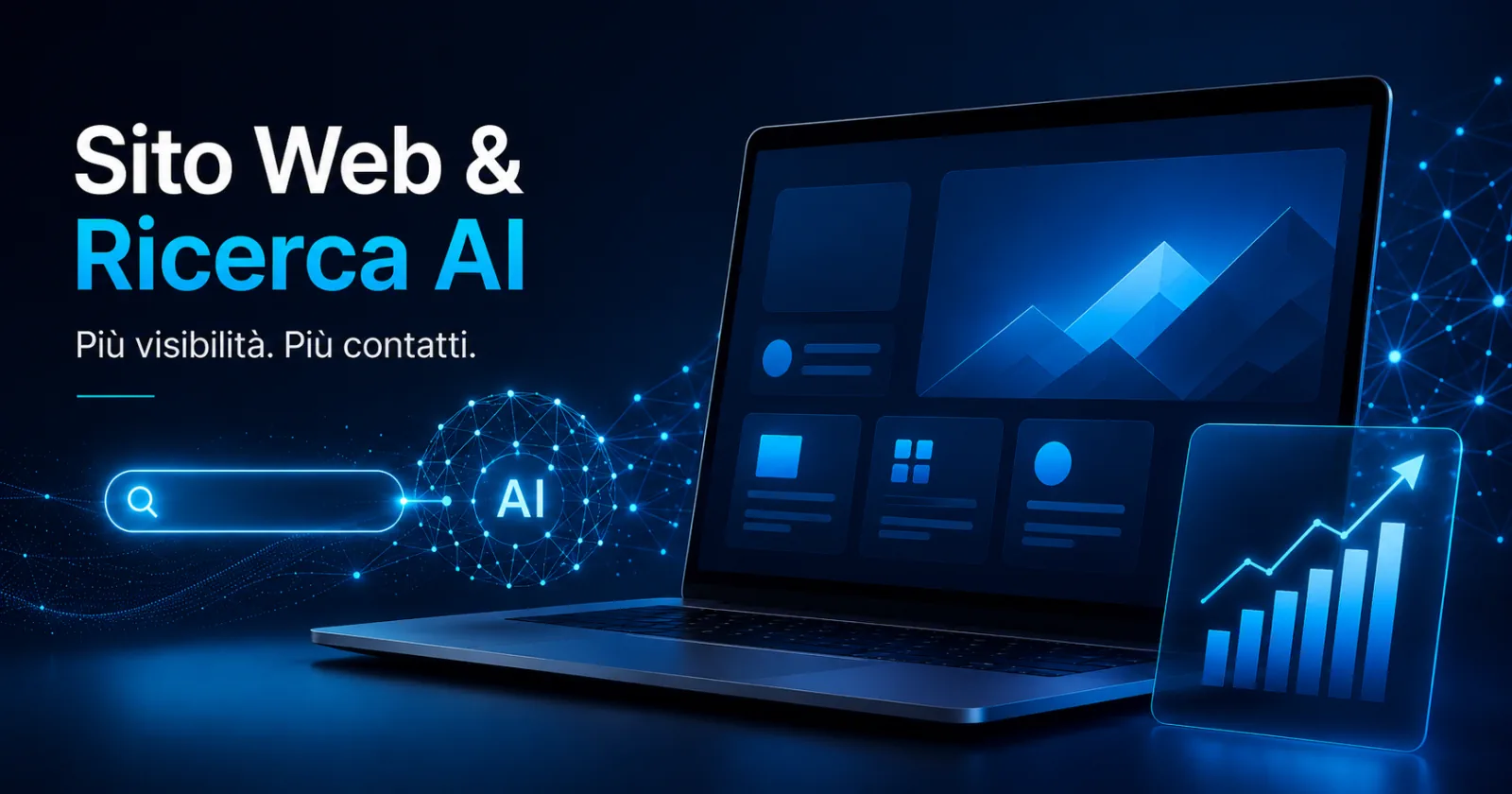
Online search is changing quickly. With AI-powered features such as AI Overviews and AI Mode, Google is changing the way people discover information, compare services and choose which companies to contact. For a small business, a professional studio or a technical company, this has a very practical consequence: simply having a website is no longer enough. The website must be clear, fast, well structured and able to turn a visit into a real enquiry.
For years, many companies treated their website as a digital brochure. A few institutional pages, a short service description, some images, a contact form and little else. That approach could work when the main goal was just to be present online. Today the website has to work harder. It must explain what the company does, be readable on mobile, load quickly, provide useful content and help potential customers understand why they should contact that specific company.
This matters because Google has started adding Search Console reporting around visibility in generative search experiences. Site owners can begin to observe how their pages appear in search contexts connected to artificial intelligence. The direction is clear: a business website must be designed not only to appear in classic search results, but also to be understood, interpreted and valued in a more advanced search ecosystem.
The website is no longer just an online presence
A modern website should answer one precise question: when a potential customer lands on a page, do they immediately understand what you offer, who it is for and why they should contact you?
Many business websites lose opportunities at this exact point. Traffic may arrive, but it does not become qualified enquiries. Pages are generic, the copy does not explain the value of the service, navigation is unclear, the form is hidden or the site does not create enough trust. The user visits the page, reads a few lines quickly and leaves without sending a request.
With AI search, this weakness becomes even more visible. If a search engine or a generative system needs to understand the content of a page, weak structure becomes a limit. Vague pages, superficial service descriptions, copied content and generic text may fail to communicate enough value. A well-designed website, on the other hand, can become a clearer and more reliable source for both people and systems that organize information online.
Why companies should act now
Updating a website today does not simply mean redesigning its visual style. Design matters, but design alone does not generate leads. A website can look pleasant and still bring no contacts if the strategy behind the pages is missing.
The real work is about structure, content, performance and the user journey. Every service should have a clear page. Every page should answer a specific need. Every piece of content should help visitors understand whether the company is a good fit for their problem. Every call to action should move the user toward contact with clarity, not pressure.
This is especially important for technical, industrial, craft and service companies. Their real value is often not immediately visible. A potential customer may not know the difference between a brochure website and a web app, between an internal dashboard and a custom management platform, or between a basic contact page and a lead acquisition flow designed properly. The website must educate, explain and guide.
An updated website can become a commercial tool. It can collect qualified requests, show expertise, present use cases, integrate better forms, connect to CRM or internal tools, publish technical news and create trust before the first direct conversation.
AI search, technical SEO and useful content
AI search does not remove SEO. On the contrary, it makes solid technical foundations even more important. A website must be indexable, fast, understandable, well linked internally and built around genuinely useful content. There are no tricks or magic formulas. What matters is a website designed properly.
Slow pages, duplicated content, generic copy, outdated sections, unclear service descriptions and hidden forms can all slow growth. A business website must explain precisely what the company does, which problems it solves and which concrete advantages it can bring to a customer.
The technical layer matters as much as the editorial layer. A good website should have a clean structure, simple navigation, dedicated service pages, mobile-readable content, fast loading times, correct SEO elements, measurable data and a clear conversion logic. Only then can it become a useful tool instead of a passive online presence.
From brochure website to working platform
The most important step is a change in mindset. A website should not be seen as a one-off cost, but as a digital platform that can grow with the company.
The first phase may involve redesigning the website or creating stronger pages for the main services. A later phase may introduce landing pages for specific campaigns, better request forms, conversion tracking and periodic content designed around real search demand.
For some companies, the website can evolve further and become a real web application. It may include a customer area, a document portal, an internal dashboard, a ticketing system, event management, data collection or a small custom management platform. At that point, the website is no longer only a communication channel: it becomes part of business operations.
This is a key difference compared with generic web development. A well-built website should not only present the company. It should help people work better, collect better data, simplify customer contact and create new commercial opportunities.
The risk of old and unclear websites
An outdated website does not damage only the company image. It can directly reduce the ability to receive enquiries. If a potential customer arrives from a smartphone and finds a slow, unreadable or outdated page, they are unlikely to fill in a form. If the services are described too generically, they will not understand whether the company can help. If they do not find examples, use cases or a clear proposal, they will postpone the decision or look for another supplier.
This happens even to very competent companies. The issue is not the quality of the work, but the way that work is communicated online. A company can have strong technical skills, years of experience and satisfied customers, but if the website does not explain that value well, part of it remains invisible.
AI search makes this even more delicate. Content must be specific, ordered and useful. Pages must answer real questions. The website must help both users and search systems understand the context, sector, services and value of the company.
How Silicon LogiX can help companies
Silicon LogiX develops websites, landing pages, dashboards and custom web platforms for companies that want to turn their online presence into a practical tool for work and customer acquisition.
The goal is not simply to build nice-looking pages. The goal is to create a digital structure that is useful, fast, clear and oriented toward contact. This may mean rebuilding a company website, creating new service pages, designing a lead-focused landing page, developing a customer portal, integrating a dashboard or building a custom web application to replace manual processes still managed with spreadsheets, email or disconnected tools.
Every project starts from a technical and commercial analysis. Before writing code or designing interfaces, it is important to understand what the website must achieve: more quote requests, more qualified contacts, better service presentation, stronger trust, automation of an internal process or support for existing customers.
From this analysis comes a proportionate solution. For some companies, a clearer and faster website is enough. For others, a more complete platform is needed, with a reserved area, content management, dashboards, custom forms, reports or integrations with existing systems.
Conclusion
Online search is entering a new phase. AI-powered features are changing how users find information and evaluate companies. In this scenario, an old, slow or unclear website can become a commercial limit.
A modern website, instead, can become a competitive advantage. It can improve visibility, increase trust, explain services more clearly and turn more visits into real contacts. Updating a website is therefore not just an aesthetic choice. It is a strategic decision.
Companies that invest now in a stronger, more technical and conversion-oriented web presence will be better prepared for new search experiences, new user behaviors and the opportunities created by the integration of websites, data, automation and artificial intelligence.
Is your website ready for AI search and real lead generation?
Silicon LogiX can review your current website, identify technical issues, weak content and conversion opportunities. We can help you build a modern business website, a lead-focused landing page, a dashboard, a customer portal or a custom web platform.
Request a technical website review