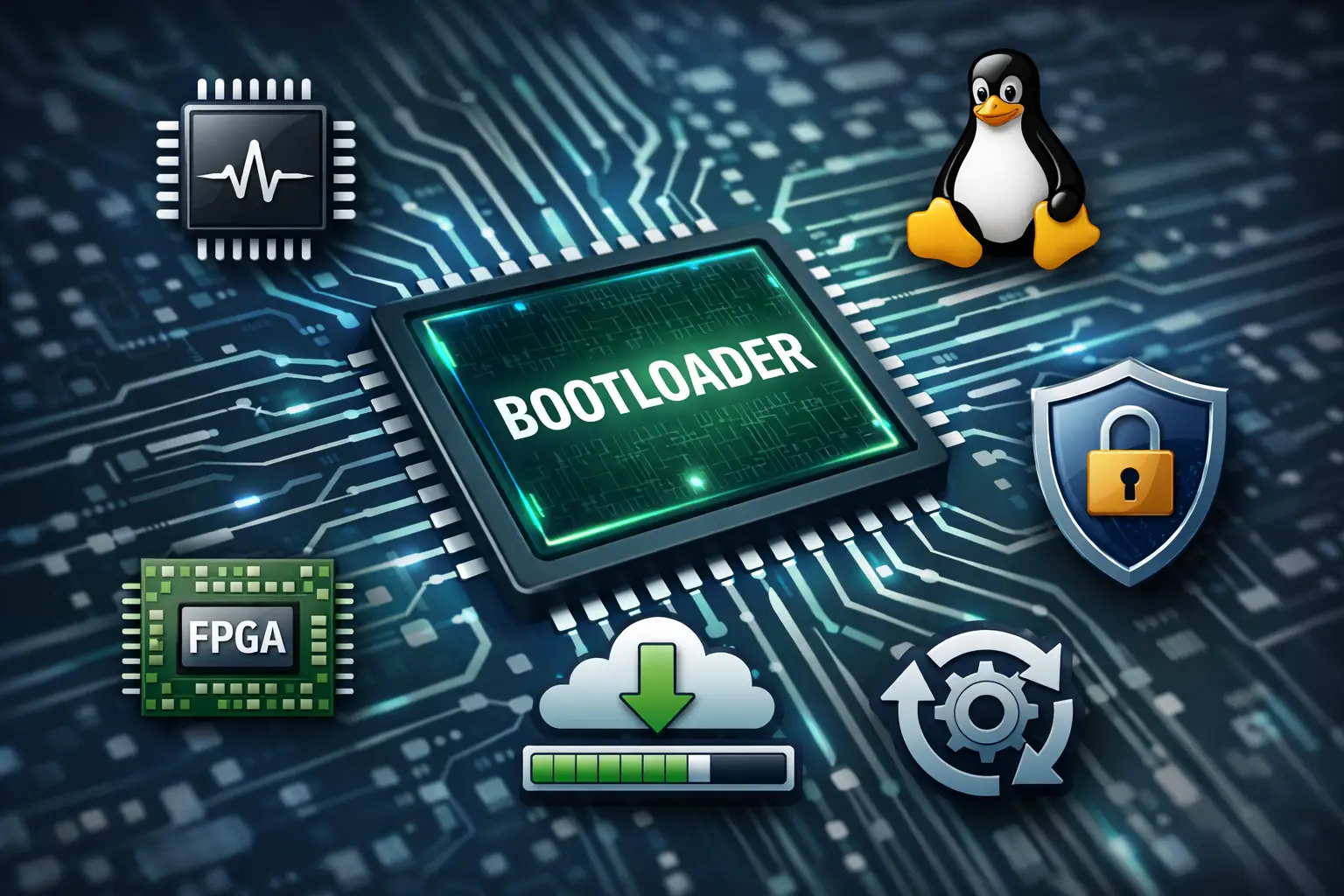
In the context of embedded systems, the bootloader represents one of the most critical and least visible components of the entire architecture. It is the first software to run after a reset and operates in a phase where the system it is in an extremely fragile state: the hardware is only partially initialized, no services exist of a high standard and the available resources are minimal.
Unlike the application, which can be updated or replaced over time, the bootloader tends to remain stable for the entire life of the product. This nature makes it a real foundation of the system, on which reliability, recoverability and maintainability depend.
From reset to execution: a critical phase of the system
The transition from reset to running the main software is often considered an implementation detail. In reality, it represents one of the most delicate phases of the entire life cycle of an embedded system. In this interval, the bootloader must take complete control of the platform and bring the hardware in a known, consistent state.
In the absence of a complete operating system and drivers, the bootloader operates at a very low level, initializing only what is strictly necessary. Incorrect sequences, incorrect timing or unconsidered hardware dependencies can introduce instabilities that will only emerge much later.
Bootloader and startup code: distinct roles
A fundamental, often overlooked distinction is that between bootloader and startup code. The startup code has the task of preparing the execution environment for the C or C++ language, initializing stack and memory and transferring control to the application entry point.
The bootloader instead introduces decision logic. It is the first software that analyzes the state of the system, evaluates the validity of the available software and consciously decides what to start. In professional embedded systems, confusing these two roles often leads to fragile solutions and difficult to maintain.
A common conceptual structure
Despite the differences between microcontrollers, embedded Linux systems, and FPGAs, the bootloader follows a common conceptual structure. After the reset, a minimal execution context is created which allows access to non-volatile memory and reading of persistent system information.
This information allows you to determine versions, validity states, and error conditions. The boot decision is therefore not a simple jump to a memory address, but the result of a structured evaluation.
The bootloader in microcontroller systems
In microcontroller-based systems, the bootloader typically operates in bare-metal mode and is subject to stringent constraints in terms of memory, startup time and complexity. The apparent simplicity of these systems hides a considerable design complexity.
The bootloader must directly manage the flash memory, taking into account physical limitations, granularity of erasure and wear. Furthermore, it must support reliable updates even in the presence of sudden resets or power interruptions.
The bootloader in embedded Linux systems
In embedded Linux systems based on System on Module, the boot process is divided into several stages. The bootloader is not a monolithic entity, but a chain that starts from the code in the SoC ROM and goes all the way to loading the kernel and filesystem.
In this context, the bootloader is responsible for initializing complex components such as DDR memory, boot configuration selection and strategy management update and fallback.
Booting in FPGA systems
In FPGA-based systems, the concept of boot extends beyond software and directly involves the hardware configuration. Before a processor can execute instructions, the bitstream must be loaded which defines the device logic.
In FPGA systems with soft-core or FPGA SoCs, the bootloader coordinates the hardware configuration and software startup, ensuring consistency between bitstream, firmware and operating system.
Updates, reliability and life cycle
The modern bootloader plays a central role in managing the firmware lifecycle. Updates often take place in less than ideal conditions, on memories subject to wear and through unreliable communication channels.
For this reason, the bootloader must be designed assuming that an update can fail at any time, adopting strategies that guarantee the recoverability of the system.
Security and validation of the boot process
Validating booted software is a fundamental aspect of the modern bootloader. The techniques adopted range from integrity checks to cryptographic authentication mechanisms.
However, boot security must be balanced with the maintainability and life cycle of the product, avoiding excessively rigid solutions that make the system difficult to update or recover.
Comparison of approaches: MCU, embedded Linux and FPGA
In microcontrollers, the bootloader is compact, deterministic, and focused on basic reliability. In embedded Linux systems it becomes a complex component, responsible for the transition towards a complex operating system. Finally, in FPGA systems, the bootloader coordinates the configuration hardware and software startup.
These differences reflect different design approaches and require specific skills to ensure consistency and reliability of the system as a whole.
The relationship between bootloader and operating system
An often overlooked aspect of bootloader design concerns its relationship with the operating system, when present. In complex embedded systems, the bootloader is not simply a code loader, but the first actor of a transition of responsibility between different software levels.
In the case of bare-metal systems or systems with lightweight RTOS, the boundary between bootloader and application is relatively clear: once the necessary checks have been carried out, control is transferred to a firmware that maintains management directly from the hardware. However, even in these cases, the bootloader must ensure that the environment left to the application is consistent with its expectations, especially in the presence of shared peripherals or partially initialized memory.
In embedded Linux systems, this relationship becomes even more delicate. The bootloader not only prepares the hardware, but it also defines the context in which the kernel will run: boot parameters, memory map, device tree, debug modes and recovery strategies. Mistakes or poorly thought-out choices at this stage they can manifest themselves much later, in the form of operating system or behavioral instability non-deterministic that are difficult to trace back to the boot phase.
The bootloader as a firmware lifecycle manager
A modern bootloader cannot be designed with only the initial startup of the device in mind. It must instead be considered as a central component in the management of the firmware life cycle, from initial programming to field updates and product decommissioning.
This implies that the bootloader must be able to interpret related persistent information system status, such as firmware versions, results of previous updates, or error conditions. This information is not only used to decide what to start, but also to provide a reliable basis on which to build progressive and safe update strategies.
In this context, the bootloader becomes a sort of system authority, the only component which can determine with certainty which software is considered valid and which should be discarded or recovered.
Firmware updates: between theory and operational reality
Update management is one of the areas where the distance between theoretical solutions and real problems become more evident. In theory, updating a firmware simply means replace one image with another. In practice, it means operating on non-volatile memories subject to wear, in the presence of unstable power supply and often through unreliable communication channels.
The bootloader must therefore be designed assuming that the update can fail at any time. This leads to the adoption of strategies that avoid irreversible conditions, such as overwriting of the only valid image available. Redundancy mechanisms, update staging and explicit confirmation of correct startup are fundamental tools to address these scenarios.
In more complex systems, such as those based on embedded Linux, these strategies also extend to the kernel and filesystem, making the bootloader a key element for ensuring updates truly atomic and recoverable.
Bootloader and hardware resource management
Another often underestimated issue concerns the management of hardware resources during the boot phase. The bootloader operates at a time when many devices are not yet initialized or they are only partially so, requiring extremely conscious management of the available resources.
Managing interrupts, clocks, and memory controllers requires special attention. A bootloader that leaves the hardware in an undocumented or inconsistent state introduces a technical debt that the application will have to compensate for, often without being aware of it.
In professional systems, the bootloader must be designed as a "polite" component, which initializes only what is strictly necessary and releases control cleanly and predictable.
The role of documentation and traceability
Unlike other software components, the bootloader is rarely modified after the initial phase of development. This makes documentation a crucial aspect, often more important than the code itself. In the absence of clear documentation, the bootloader risks becoming a real black box.
Document architectural choices, memory map, boot flows, and error conditions it is essential to guarantee the continuity of the project, especially in industrial contexts or long term.
Bootloader testing: beyond the nominal case
Bootloader testing requires a profoundly different approach than application testing. It is not enough to verify that the system boots correctly under ideal conditions; it is necessary to consider degraded scenarios and anomalous conditions.
Sudden resets, unstable power supply, partially corrupted memories or incompatible firmware must be considered an integral part of the validation process. A bootloader that only works in perfect conditions cannot be trusted.
Startup time considerations
In many embedded systems, startup time is a critical parameter. The bootloader contributes significantly to this aspect, since it is responsible for the first operations performed after the reset.
Reducing startup time does not mean eliminating controls, but optimize the initialization sequences and balance correctly speed and reliability, based on deep understanding hardware and software dependencies.
The bootloader as an expression of design maturity
The bootloader represents one of the best indicators of the maturity of an embedded project. Improvised or minimal solutions can work in the initial stages, but they tend to show their limitations when the system is deployed on a large scale or used in critical contexts.
A carefully designed bootloader reflects a systemic vision, which takes into account the entire life cycle of the product and real operating conditions and maintenance needs over time.
Final thoughts
The bootloader is not an implementation detail, but a structural element of embedded engineering. It is the first software to run and, in many cases, the only component that delivers the recoverability of the system in critical conditions.
A carefully designed bootloader reflects a systemic vision oriented towards reliability, to maintainability and sustainability over time, regardless of the technological platform used.
Design a reliable bootloader for your embedded systems
Silicon LogiX supports the design of robust and maintainable boot architectures for microcontrollers, embedded Linux systems and FPGAs, with particular attention operational reliability, field updates and cycle management firmware life.
Request advice on boot architecture