
Matter: the IP standard that truly unifies the smart home (and home IoT)
Matter is an open and interoperable application standard that brings a common data model and a uniform interaction model over IPv6 networks
(Wi-Fi, Ethernet, Thread). The goal: to make devices and platforms of different brands talk to each other - locally, in a secure way - reducing
integration and maintenance costs along the product life cycle. At the network level, discovery and control take place on DNS-SD/mDNS,
with operations exposed from a set of standard clusters (attributes, commands, events) and end-to-end secure sessions. The published service for operational nodes
is _matter._tcp and the official port is 5540 (TCP/UDP).
From 2024 to mid-2025, the standard has significantly expanded its use cases: more efficient Intermittently Connected Devices (ICDs), end-to-end energy management
and — with release 1.4.2 (August 2025) — a focus on reliability/stability, certifiable scenes, and Wi-Fi-only (no BLE) onboarding for Wi-Fi-only products.
Practical adoption depends on individual ecosystems, but the direction is clear.
Why Matter matters to those who design products
- Multi-ecosystem interoperability: same application language towards Apple, Google, Amazon, SmartThings and Home Assistant.
- Reduction of firmware variants: the same device type and the same clusters apply to multiple platforms.
- Standard onboarding: predictable pairing (QR/manual code), DNS-SD/mDNS discovery, common operational credentials.
- End-to-end security And Standardized OTA: fewer ad-hoc solutions, more "platform" maintenance.
3-layer architecture
1) IP transport
Matter runs on IPv6 (Wi-Fi, Ethernet, Thread). Application sessions can use UDP with Message Reliability (retransmissions, acks, anti-duplicates) or TCP where appropriate. There IPv6 multicast it is crucial for groups and scenes.
2) Service Discovery
Discovery occurs via DNS-SD/mDNS (RFC 6763).
In the operational phase the nodes publish the service _matter._tcp and they talk at the official door
5540 (TCP/UDP) registered at IANA.
3) Data Model & Interaction Model
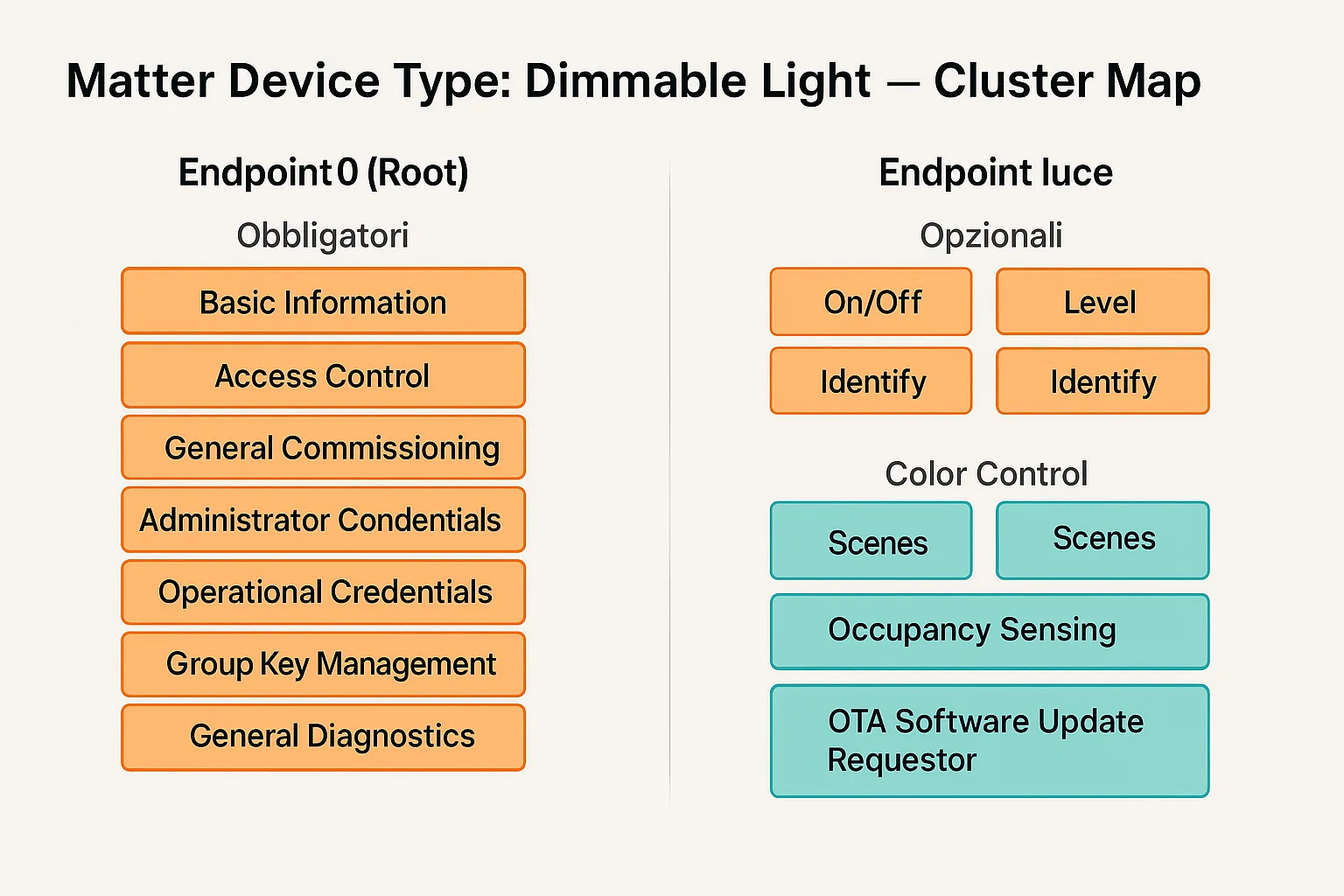
The Data Model defines node, endpoint, cluster (attributes, commands, events) and device type. THE'Interaction Model standardizes operations Read, Write, Invoke, Subscribe (also in multicast for group actions). Useful introductions: Google Developers – Device Data Model And Silicon Labs – Matter Fundamentals.
Security: chain of trust, fabric and ACL
Initial commissioning
Pairing uses PASE (SPAKE2+ with QR/NFC passcode or manual code) to create the secure channel and transfer the initial parameters. The commissioner verifies the identity of the device via Device Attestation (chain DAC → PAI → PAA And Certification Declaration). Public PAA root certificates reside in the Distributed Compliance Ledger (DCL).
Operation
In exercise, the sessions are HOUSES (mutual authentication with certificates) and the node enters a fabric (security domain). The multi-admin allows the same device to be part of multiple fabrics/ecosystems. Practical insights on certification: Silicon Labs – Device Attestation And DigiCert – Issuing CSA Matter Certificates.
Operation: CASE, fabric and multi-admin
In operation the sessions are CASE (mutual authentication with certificates); the fabric is the security domain that groups shared nodes, IDs, and trust anchors. A device can belong to multiple fabrics (multi-admin) and therefore coexist on multiple ecosystems (e.g. Home, Alexa, Google, SmartThings) without different firmware.
Permissions: Access Control Cluster (ACL)
Permissions are declarative and per-cluster: View, Operate, Manage, Administer (standard privileges). In the absence of adequate privilege, a transaction is denied.
Network and discovery: project notes
- mDNS/Multicast: Make sure 5353/UDP and IPv6 multicast are not filtered on LAN/VLAN (overly aggressive IGMP snooping can break discovery).
- Port 5540: open 5540 TCP/UDP between controller and device for operational Matter traffic (IANA).
- Local IPv6: link-local is sufficient for LAN operations; public IPv6 is not needed.
Wi-Fi, Thread, Ethernet: when to choose what
Wi-Fi/Ethernet: high throughput and low latency (advanced lights, bridges, large appliances). Threads: Low-power IPv6 mesh for battery-powered sensors/actuators; requires a Thread Border Router to interface with the home IP (many consumer hubs integrate it).
Recent changes to the standard
- Matter 1.4: extensions for energy management (new device types such as solar panels, batteries, heat pumps, water heaters) and multi-ecosystem improvements. Source: CSA Newsroom.
- Matter 1.4.2: focus on reliability/stability e Wi-Fi only commissioning via USD Wi-Fi (no BLE requirement), as well as more consistent scenes across ecosystems. Source: CSA Newsroom.
Devices, clusters and “system” functions
- Application clusters: On/Off, Level/Color Control, Thermostat, Door Lock, Window Covering, Robot Vacuum, etc.
- Groups & Bindings: efficient multicast for simultaneous actions (e.g. all lights in the room) and controller→device logical links.
- Scenes: Multi-device state snapshot with consistent and certifiable behavior in recent releases.
- Bridge: Role to expose Zigbee/Z-Wave/BLE Mesh devices as Matter virtual endpoints.
Standardized OTA updates
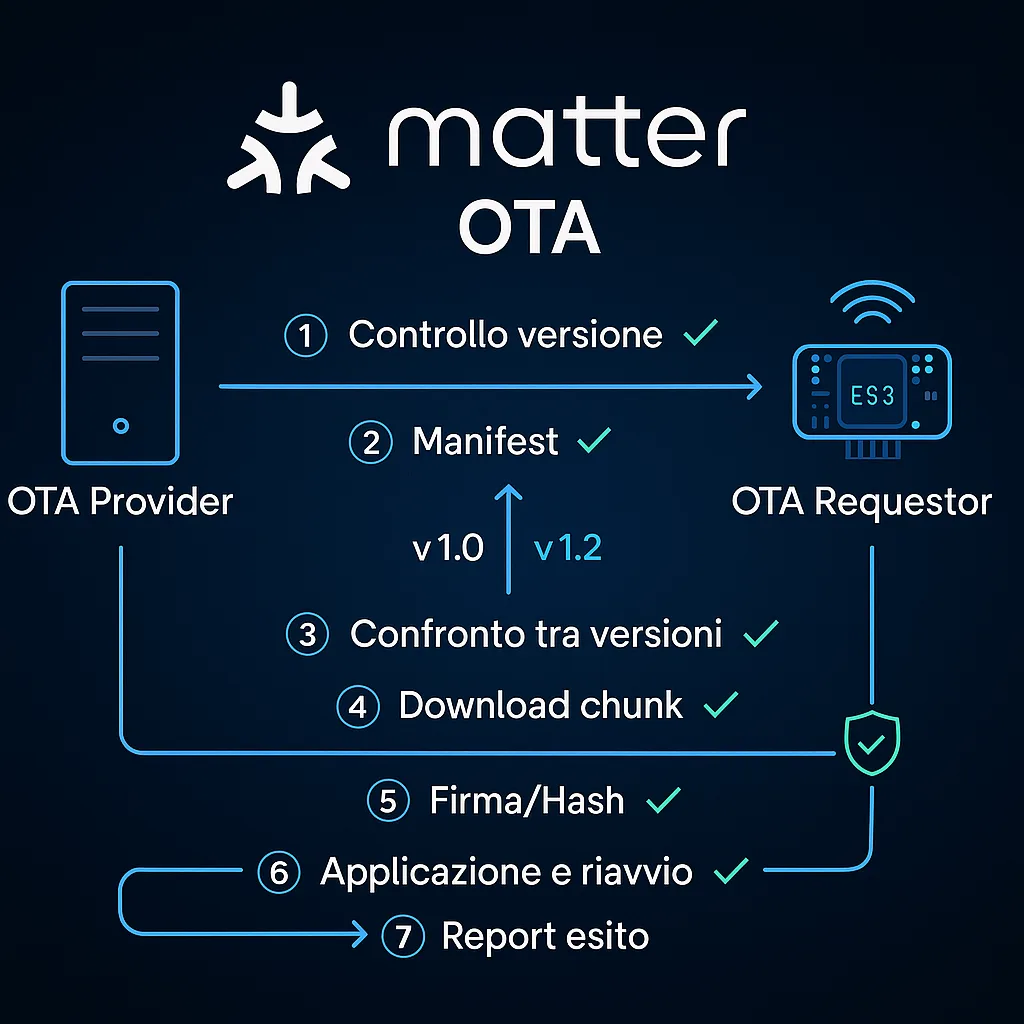
The OTA is an integral part of the specification: a Requestor can locate a Providers Matter, Download a compatible image and install it safely. Some hubs can act as OTA Providers within the fabric. Reference documentation in specifications and vendor portals (CSA, Silicon Labs, NXP, etc.).
Production and certification: what is really needed
- Production PKI: generation of DAC unique, vendor PAI/PAA (or accredited CA) aligned with CSA policies; publishing artifacts and CRL in DCL.
- Certification Declaration (CD): issued following compliance; it must be managed as an updateable artifact.
- Compliance & testing: PICS/PIXIT, CSA test suite, multi-ecosystem testing and energy profile verification where applicable.
Design checklist (without platform lock-in)
- Device type & Data Model: Define endpoints/clusters (mandatory + optional that give real value).
- PKI: Plan PAA/PAI/DAC, key management (ideally in secure element) and provisioning processes.
- Net: enable mDNS (5353/UDP), IPv6 multicast and 5540 TCP/UDP on the LAN and any VLANs.
- ICD/Power: for drums, use windows of check in, on-change reports and long idle times.
- OTA: immediately integrates OTA Matter to reduce field update and support costs.
- Bridge & migration: If you have a Zigbee/Z-Wave installed base, consider a Matter bridge for smooth transitions.
Essential glossary
Fabric Security domain with CA, operational credentials (NOC) and shared identifiers. A device can belong to multiple fabrics. PASE / HOUSES Commissioning session (SPAKE2+ passcode) / operational session (certificates) between Matter nodes. DAC / PAI / PAA Device attestation chain. The public PAA roots are in the DCL; the CD certifies the conformity of the product. IM (Interaction Model) Read, Write, Invoke, Subscribe: the standard operations on the Data Model. ICD Intermittently Connected Device: Intermittently connected devices with optimized wake-up policies.
References and insights
- CSA – Build with Matter
- RFC 6763 – DNS-SD | IANA – Port 5540
- Google – Matter Device Data Model
- Silicon Labs – Matter Fundamentals
- CSA – Distributed Compliance Ledger
- CSA – Announcement Matter 1.4 | CSA – Update 1.4.2
- NXP – Energy Management in Matter 1.4
Note: This article is intended as a technical introductory guide. For implementation details (SDK and platforms), please refer to the vendor documentation and the official Matter specification.
Conclusion
Matter is not “another radio protocol,” but a common application language over IP that normalizes discovery, security, data model and updates.
For product developers, it means fewer firmware variants, predictable onboarding, cross-platform integration, and a clear roadmap on power and scalability.
With the latest releases (1.4 and 1.4.2), the standard is maturing precisely where it is needed: reliability, management of complex scenarios (scenes, groups, energy) and
simplification of onboarding.
If you want, we can later transform this article into a practical-engineering guide (with diagrams and operational checklists for certification/PKI, networks, ICD and OTA)
or in a downloadable whitepaper with infographics.
Do you have a project to carry out?
Silicon LogiX designs end-to-end IoT solutions: from low-level firmware on ESP32 to Web UI, up to mobile apps and cloud backends, taking care of Wi-Fi/BLE connectivity, security and scalability — contact us for consultancy or a tailor-made project.
Contact me

