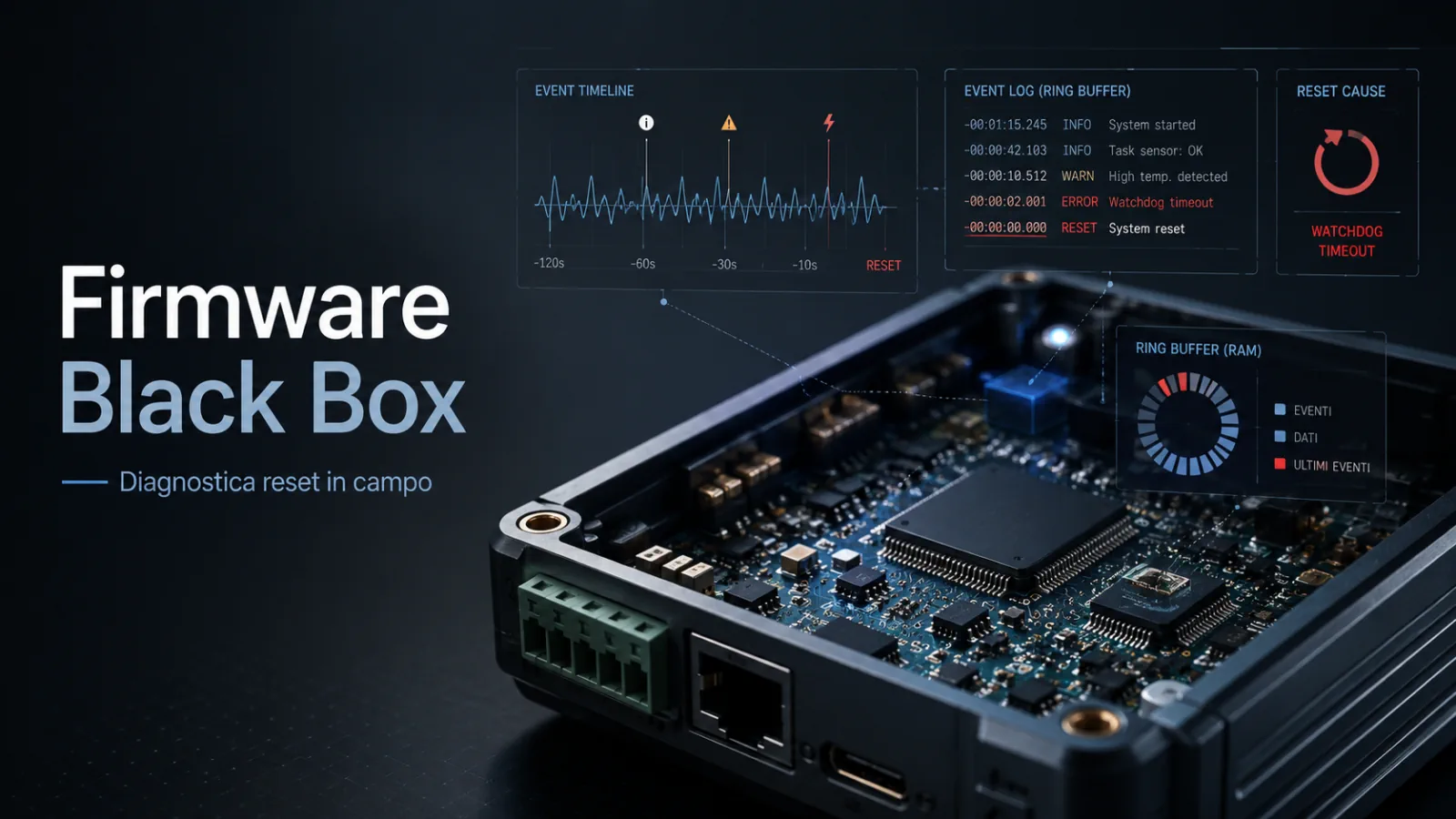
eBPF is becoming one of the most interesting technologies for teams that build and maintain embedded Linux systems. In server and cloud environments it is already widely used for observability, networking and security, but its value becomes even more interesting when it is applied to industrial gateways, embedded routers, IoT devices, edge systems, Linux-based appliances and products already installed at customer sites.
The important question is not only "what is eBPF?". For an embedded team, the better question is: can we observe, diagnose and protect a production Linux device without continuously changing the kernel or rebuilding the whole firmware image?
In many embedded products, debugging becomes difficult exactly when the device is already in the field. A network issue, unexpected latency, a process consuming too much CPU, a suspicious system call or intermittent kernel behavior can require days of analysis. In these scenarios, eBPF can become a powerful way to collect information directly from the operating system, in a controlled way and with limited overhead.
What eBPF is
eBPF, short for extended Berkeley Packet Filter, is a Linux kernel technology that allows small programs to run at specific points inside the operating system. These programs can be attached to network events, system calls, tracepoints, kernel functions, security events or other hooks exposed by the kernel.
The idea is simple: instead of changing the kernel, recompiling it or loading a traditional kernel module, it is possible to load a verified eBPF program, run it when a specific event occurs and collect data or apply small pieces of control logic.
This does not mean that eBPF makes the kernel "freely modifiable". The opposite is true: one of the key aspects is control. Before it runs, an eBPF program is analyzed by the kernel verifier, which checks that the code respects safety, memory access and termination constraints. This mechanism is what makes eBPF very different from a classic kernel module.
Why eBPF is interesting for embedded Linux
In modern embedded systems, Linux is no longer used only as a general-purpose operating system. It is often the core of industrial gateways, IoT devices, routers, HMIs, data concentrators, telemetry systems, edge computers and connected appliances. These products must remain reliable, updateable, observable and secure over time.
The problem is that, once a device is installed, every software change becomes more delicate. Updating a kernel, adding logs inside a driver, rebuilding a Yocto distribution or deploying a new firmware image is not always immediate. It can require testing, validation, controlled rollout and recovery procedures.
eBPF fits into this space because it can increase visibility into the real behavior of the system without necessarily changing the kernel baseline or introducing invasive tools. In an embedded product, this can reduce diagnostic time, improve maintainability and support more advanced runtime security strategies.
The main advantage: observing the system without recompiling the kernel
In a traditional embedded workflow, when a new debug signal is needed, the team often has to change code, add logging, rebuild, regenerate the image, update the device and reproduce the issue. This process can work in the lab, but it becomes expensive when the bug appears only on devices installed at customer sites or under operating conditions that are hard to reproduce.
With eBPF, in several scenarios, it is possible to load observability tools at runtime, collect metrics from the kernel and remove them when they are no longer needed. This does not remove the need for good embedded design, but it adds a very useful dynamic analysis layer for Linux-based products.
For example, a team can measure how often a system call is invoked, observe I/O latency, count network packets, monitor errors, analyze filesystem events or detect unusual process behavior patterns. All of this can be done with controlled impact and without turning every diagnostic activity into a new firmware release.
Practical eBPF applications in embedded systems
In embedded engineering, eBPF should not be treated as a technology trend. It should be used where it creates a real advantage. The most interesting areas are diagnostics, networking, security and production monitoring.
Diagnostics on devices already installed in the field
One of the most important use cases is production diagnostics. An embedded Linux device may behave correctly in the lab but show issues only in the field: unstable networking, slow storage, abnormal CPU usage, watchdog resets, intermittent hangs, unexpected latency or behavior that is difficult to reproduce.
With eBPF, it is possible to collect data closer to the kernel and reduce dependency on incomplete application logs. This helps the team understand what is really happening in the system: which processes are creating load, which system calls are most frequent, which network paths are involved or where delays accumulate.
Networking for gateways, routers and edge devices
Networking is one of the areas where eBPF has gained the most adoption. On IoT gateways, embedded routers, industrial firewalls and edge devices, it can be used to observe, filter or classify network traffic.
A particularly interesting case is XDP, which allows eBPF programs to run very early in the packet receive path. This can be useful for filtering, protection against unwanted traffic, statistics collection or fast decisions before a packet travels through the whole network stack.
Of course, in embedded systems the hardware, network driver, kernel support and available resources must always be evaluated. Still, for devices that continuously handle data traffic, eBPF can become an important tool for improving visibility and control.
Runtime security and hardening
Embedded device security does not end with secure boot, OTA updates, filesystem permissions or firewall configuration. More and more often, teams also need to understand what happens during execution: which processes access specific resources, which system calls are invoked, which connections are opened and which behaviors may indicate an anomaly.
eBPF can support this runtime visibility. It can monitor sensitive events, observe system calls, collect useful data for security audits or implement targeted controls. It does not replace a complete cybersecurity strategy, but it can become a useful component in architectures where observability and security must coexist.
Profiling and performance optimization
Embedded systems have limited resources. CPU, RAM, storage, network bandwidth and power consumption must be managed carefully. When an application or service behaves abnormally, understanding where time is being spent is often more valuable than simply adding more hardware.
eBPF can help measure latency, identify bottlenecks and understand which parts of the system are generating the most overhead. This is useful both during development and during optimization work on mature products.
eBPF is not only a server tool
Many people associate eBPF with Kubernetes, cloud networking, enterprise observability or security monitoring on large infrastructures. That association is correct, but incomplete. The same technology can also be useful in embedded Linux systems, as long as tools, configuration and workflows are adapted to the real device context.
An industrial gateway does not have the same resources as a cloud server. A minimal Yocto image cannot always afford heavy toolchains, interpreters, debug libraries and generic tools. For this reason, when discussing embedded eBPF, the point is not to install everything that would be used on a workstation. The point is to choose precisely what is actually needed.
In many cases, the professional choice is to build tools off-target, keep the device lightweight and deploy only the components required to load and run specific eBPF programs. This approach is more appropriate for embedded products, where image size, attack surface and build repeatability are critical factors.
Typical architecture of an embedded eBPF solution
An eBPF solution usually has two parts: an eBPF program running in the kernel and a user-space application that loads it, configures it and reads the collected data. Communication between kernel and user space often happens through structures called BPF maps.
In embedded systems, this separation is very useful. The eBPF program can focus only on event collection or filtering, while the user-space application can export metrics, write logs, send data to a remote service or integrate with a local dashboard.
| Component | Role | Embedded impact |
|---|---|---|
| eBPF program | Runs in the kernel when a specific event occurs | Must be small, verifiable and designed to reduce overhead and complexity |
| Verifier | Checks the program before execution | Improves safety compared with traditional kernel modules, but imposes constraints on the code |
| BPF maps | Exchange data between kernel and user space | Useful for counters, metrics, configuration and temporary data |
| User-space loader | Loads and attaches the eBPF program to the correct hooks | Can be written in C, Go, Rust or with dedicated libraries |
| Data export | Turns collected data into logs, metrics or reports | Can integrate with local dashboards, APIs, log files or remote systems |
eBPF and Yocto: controlled integration in a custom distribution
For many professional embedded products, Yocto is the ideal base for creating repeatable and customized Linux images. In this context, eBPF should be integrated with the same logic: not as a package added manually, but as a controlled part of the distribution.
The first activity is verifying that the kernel has the required options enabled. Then the team must decide which tools should be included in the target image. During development, more complete tracing tools may be useful; in production, it is usually better to minimize what is installed on the device.
A professional approach can use different images: a development image with more tracing tools, a test image for validation and a production image with only the strictly required components. This keeps flexibility during debugging without unnecessarily increasing product size or exposure.
ebpf_embedded_strategy:
  development_image:
    tracing_tools_available: true
    debug_symbols_available: true
    kernel_config_visible: true

  production_image:
    minimal_loader_included: true
    only_required_bpf_programs: true
    unprivileged_bpf_disabled: true
    attack_surface_reduced: true

  build_process:
    kernel_config_versioned: true
    bpf_objects_built_reproducibly: true
    target_architecture_validated: true
    release_artifacts_tracked: true
When eBPF can create value in an embedded product
eBPF is especially useful when the device is complex, connected and expected to remain in the field for years. In these cases, the value is not only technical. It is also operational and commercial. Reducing diagnostic time, improving visibility into real issues and supporting long-term maintenance means lowering support cost and improving perceived reliability.
A manufacturer of industrial gateways, for example, can use eBPF to analyze network traffic and latency issues. A company building Linux appliances can use it to understand which processes create abnormal load. A team managing IoT devices can use it to collect diagnostic information without continuously deploying new debug builds.
The value increases when eBPF is designed as part of the product maintenance strategy, not as an improvised emergency tool.
When caution is needed
eBPF is not always the right choice. On very small devices, with old kernels, limited resources or extremely minimal images, the integration cost may exceed the benefit. Also, enabling advanced kernel functionality without a security strategy can increase the attack surface.
The kernel version, CPU architecture, JIT support, security configuration, required permissions, memory consumption and tools installed on the target must all be evaluated carefully. An eBPF solution designed for a server cannot simply be copied to an embedded device without adaptation.
The point is not to use eBPF everywhere. The point is to understand where it can provide a measurable advantage. In some cases, good logging will be enough. In others, classic tracing tools are the right answer. In others again, eBPF can become the most efficient way to observe the system in depth.
eBPF, kernel modules and traditional logging: practical differences
To understand the role of eBPF, it is useful to compare it with more traditional approaches. A kernel module provides high flexibility, but it also introduces high risk: a bug can compromise system stability. Application logging is simple to use, but it only sees what the application chooses to record. Classic tracing tools are useful, but they are not always suitable for minimal embedded images or production scenarios.
| Approach | Advantage | Limit |
|---|---|---|
| Application logging | Simple to implement and integrate | Does not directly observe the kernel, system calls, networking or drivers |
| Kernel module | Maximum flexibility in kernel space | Riskier, more invasive and more delicate to maintain |
| Traditional tracing | Useful in development and debugging | Can be heavy or poorly suited to embedded production images |
| eBPF | Dynamic, verified observability attached to kernel events | Requires a suitable kernel, specific skills and controlled integration |
Technical checklist for evaluating eBPF on embedded Linux
Before introducing eBPF into an embedded product, it is useful to run a technical audit. The goal is not only to check whether it "works", but to understand whether it can be integrated in a reliable, secure and maintainable way.
ebpf_embedded_audit:
  kernel:
    kernel_version_checked: true
    bpf_support_enabled: true
    required_hooks_available: true
    architecture_jit_support_verified: true

  security:
    unprivileged_bpf_policy_reviewed: true
    capabilities_required_documented: true
    production_access_restricted: true
    attack_surface_evaluated: true

  build_system:
    yocto_integration_checked: true
    toolchain_strategy_defined: true
    bpf_objects_reproducible: true
    debug_and_production_profiles_separated: true

  runtime:
    cpu_overhead_measured: true
    memory_usage_measured: true
    long_running_test_completed: true
    failure_behavior_verified: true

  observability:
    metrics_defined: true
    maps_size_reviewed: true
    export_format_defined: true
    logs_or_dashboard_integrated: true

  maintenance:
    kernel_upgrade_strategy_defined: true
    bpf_program_versioned: true
    rollback_plan_available: true
    customer_support_workflow_defined: true
Suggested mini adoption plan
To introduce eBPF into an embedded Linux product, it is better to proceed gradually. The first step should be a concrete use case: measuring latency, analyzing traffic, monitoring system calls or collecting specific metrics. Starting from a real objective prevents eBPF from becoming a technology experiment with no product impact.
| Phase | Goal | Expected output |
|---|---|---|
| 1. Initial audit | Verify kernel, configuration, architecture, toolchain and device constraints | Technical report with feasibility, risks and priority use cases |
| 2. Proof of concept | Implement a focused eBPF program for a real problem | Collected metrics, measured overhead and validated behavior |
| 3. Yocto integration | Bring loader, BPF objects and configuration into the embedded build | Repeatable image with development, test and production profiles |
| 4. Production validation | Define permissions, security, logging, updates and recovery | Solution ready for technical support, diagnostics or runtime monitoring |
The business value of eBPF in embedded Linux products
For a company building Linux-based devices, eBPF can become a competitive advantage. Not because it is a new technology, but because it helps manage real problems: technical support, remote debugging, security, performance and long-term maintenance.
A reliable embedded product is not only a device that works at first boot. It is a system that can be observed, updated, diagnosed and maintained throughout its life cycle. In this sense, eBPF can help turn diagnostics from a reactive activity into an engineered capability.
This is especially important for industrial gateways, IoT devices, custom routers, edge appliances and systems installed in environments where stopping the product or physically replacing the device is expensive.
FAQ about eBPF and embedded Linux
Can eBPF be used on any embedded Linux device?
No. It depends on the kernel version, configuration, CPU architecture, support for the required hooks and available resources. A technical check of the target is needed before adoption.
Does eBPF replace kernel modules?
Not completely. Kernel modules are still necessary for many low-level functions, especially drivers and hardware integrations. eBPF is better suited to observability, filtering, tracing, networking and limited runtime controls.
Is eBPF safe for production devices?
It can be, if it is integrated correctly. The kernel verifier reduces risk compared with arbitrary kernel code, but privileges, program loading access, kernel configuration and attack surface must be managed carefully.
Do heavy tools need to be installed on the device?
Not necessarily. In embedded systems, it is often better to build off-target and install only what the device needs. Full tools such as bpftrace or BCC can be useful in development, but they are not always appropriate for a production image.
Is eBPF useful with Yocto?
Yes. Yocto is a very suitable context because it lets the team control the kernel, packages, libraries, image profiles and build artifacts. The important part is to design the integration repeatably instead of adding tools manually to the target.
What is the main risk when introducing eBPF?
The main risk is treating it as a simple debug tool without a strategy. In an embedded product, the team must evaluate overhead, security, kernel compatibility, maintenance and the difference between development and production environments.
Useful technical references
- eBPF.io - What is eBPF?
- Linux Kernel Documentation - BPF
- Linux Kernel Documentation - eBPF Verifier
- Linux Kernel Documentation - libbpf overview
- eBPF Docs - libbpf
- Cilium - BPF and XDP Reference Guide
- Cilium - Introduction to eBPF and XDP
- bpftrace Documentation
- Yocto Project Wiki - Tracing and Profiling
Conclusion
eBPF is an important evolution for embedded Linux. It makes it possible to observe kernel behavior, collect runtime data, analyze network traffic, improve diagnostics and support more advanced security strategies without continuously changing the kernel or deploying new firmware images for every debug need.
For embedded teams, however, the point is not to adopt eBPF because it is a modern technology. The point is to understand whether it can solve a concrete problem: reducing diagnostic time, improving visibility into devices already in the field, strengthening networking control or making maintenance of Linux-based products more professional.
In an industrial gateway, a custom router, an IoT device or an edge appliance, eBPF can become a very powerful tool. But it must be introduced methodically: kernel audit, resource verification, build integration, separation between development and production, privilege control and overhead measurement.
When designed correctly, eBPF is not only a debug tool. It becomes part of the product strategy for reliability, security and maintenance.
Do you have an embedded Linux device that needs diagnostics, optimization or better observability?
Silicon LogiX supports companies and technical teams in the development and review of embedded Linux systems, Yocto, industrial gateways, IoT devices, embedded networking, runtime security, kernel-level diagnostics and maintenance strategies for products already in the field. A technical audit can help you understand whether eBPF, tracing or advanced observability tools can reduce debug time, operational risk and production regressions.
Request an embedded Linux audit