In recent years we have heard a lot about Industry 4.0, characterized by automation, IoT, artificial intelligence and increasingly connected production processes. Today a new paradigm is emerging: Industry 5.0, where technology does not replace human beings, but supports them, amplifying their abilities and creativity.
What does Industry 5.0 mean
If the fourth industrial revolution focused on efficiency and digitalisation, the fifth puts it at the centre man-machine collaboration. The goal is not only to produce more and faster, but produce better, in a personalized, sustainable and safe way: advanced automation and human intelligence work together to improve quality, safety and flexibility.
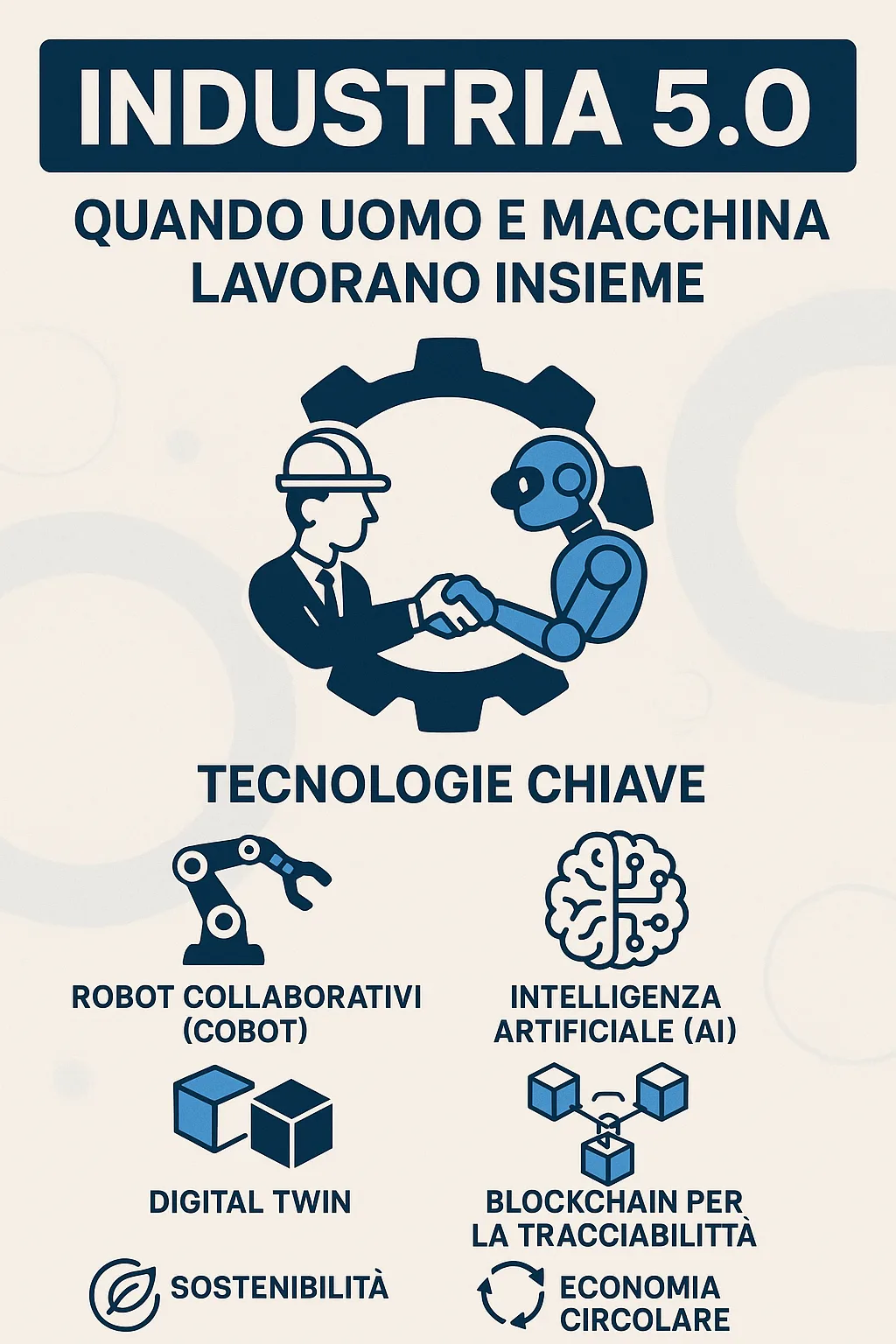
The key technologies
- Collaborative robots (cobots): they work side by side with operators, with sensors and safety logic that allow natural interaction.
- Artificial intelligence: maintenance and predictive quality, real-time optimization of process parameters, artificial vision.
- Digital Twin: they simulate plants or machines in real time for testing, debugging and optimization before intervening in the field.
- Edge Computing & Industrial IoT: local processing for minimal latency, resilience and timely decisions; protocols such as MQTT, integration with MES/SCADA systems.
- Traceability (also with DLT/Blockchain technologies): supply chain integrity, from raw material to finished product.
- Sustainability and circular economy: energy monitoring, waste reduction, material recovery, impact KPIs.
A human-centered approach
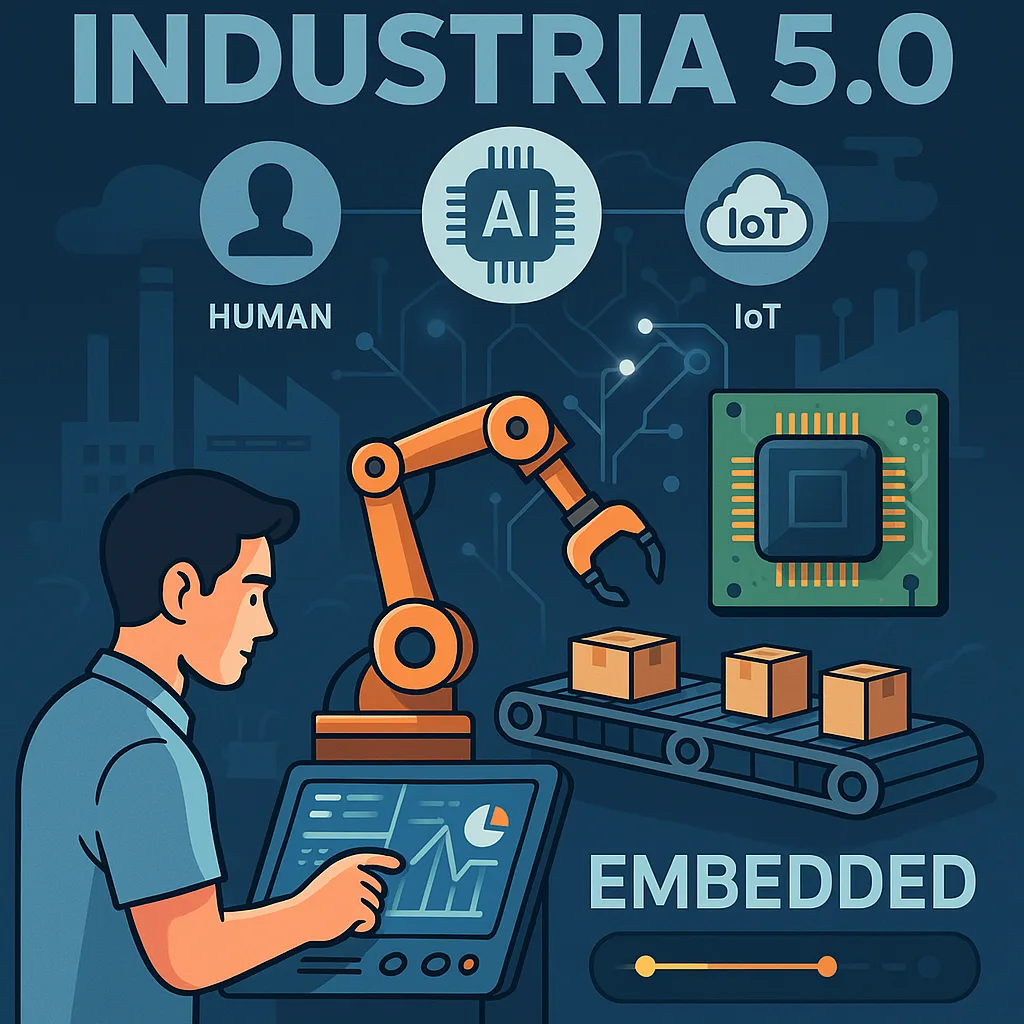
Technology becomes a partner: the operator is supported by AR for online instructions, cobots manage repetitive or burdensome tasks, AI provides suggestions and insights. Decisions remain ultimately human, with more powerful tools and better data.
Transition 5.0: operational guidelines
Many public incentives and programs promote digital and energy transformation. In practice, companies can focus on:
- Investments in related tangible/intangible assets (machines, sensors, software, cybersecurity).
- Energy efficiency and monitoring of consumption along the process.
- Training of staff on AI, data analytics, security and new HMIs.
- Pilot projects measurable (clear KPIs) before scaling up the lines.
Note: See the official page of Ministry of Business and Made in Italy for more details and technical documents.
Impact on embedded & firmware
Reliable and updatable firmware (also OTA), integration with industrial buses (CAN, Modbus, EtherCAT), by-design security, diagnostics and telemetry: these are prerequisites for truly scalable and maintainable systems.
Why act now
Companies that embrace the concept of Industry 5.0 today will be ready to compete in a market where customization, speed and sustainability are the keys to success. This is not a passing trend, but an inevitable evolution of industrial production.
Conclusion
Industry 5.0 is the meeting point between intelligent automation and human creativity. It's the future of work, where technology and people are not in competition, but part of the same team. Whoever knows how to best integrate them will be the protagonist of the next industrial revolution.