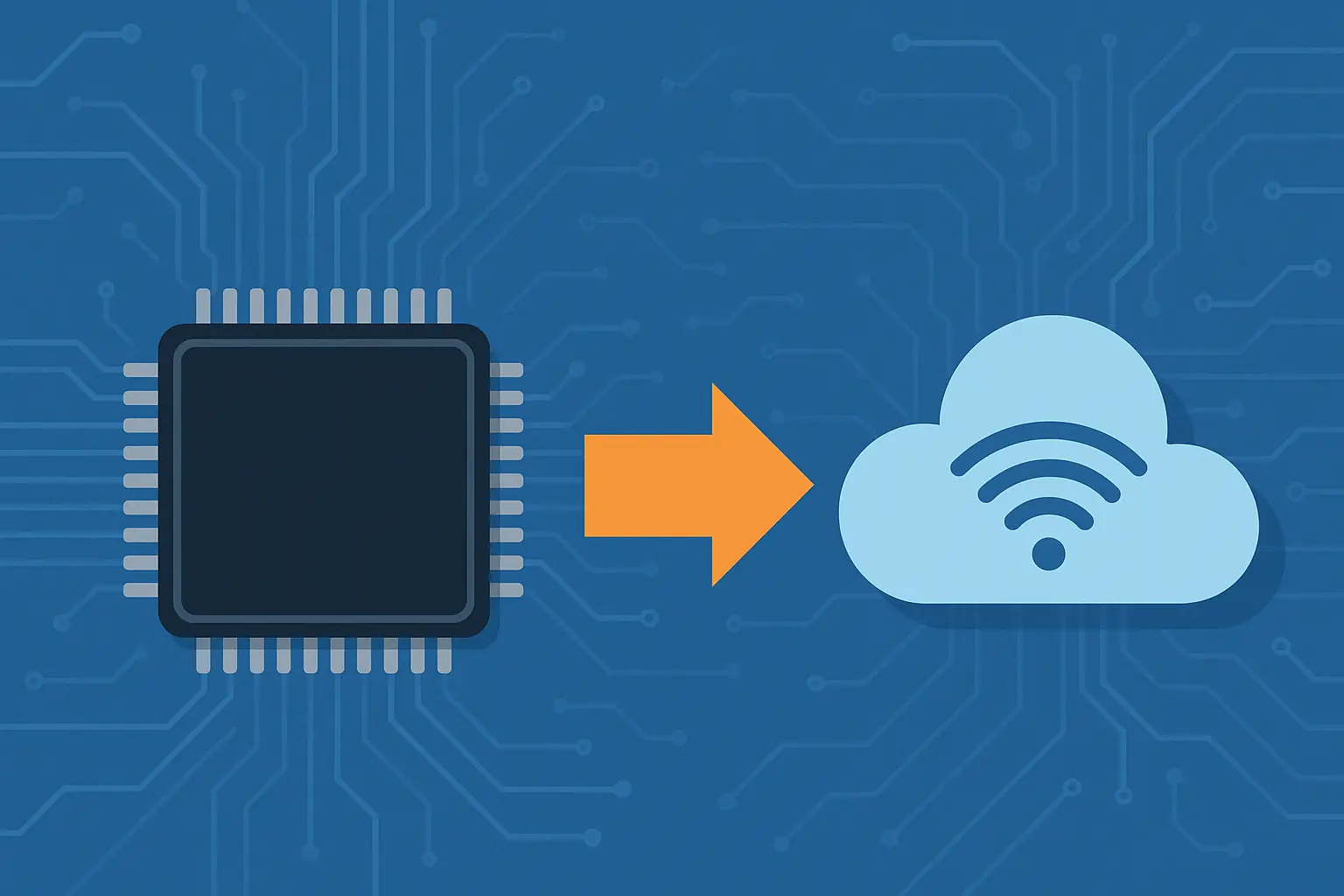
In recent years the Cloud has represented the fulcrum of most IoT architectures: devices collected data, and remote servers processed each subsequent step. In 2026, However, the landscape is changing rapidly. The increase in costs, the need to reduce the latency and a growing focus on privacy are pushing many companies to reconsider this model. In parallel, the new generation of microcontrollers allows today to perform advanced processing directly on the device, inaugurating a progressive transition from centralized processing to edge computing.
The Cloud in 2026: from central resource to critical cost
The Cloud continues to offer enormous value in terms of scalability and reliability, but in 2026 it is revealing increasingly significant limitations. Operating costs are increased steadily, especially in IoT services and data transfer. Many projects which provide devices that are active 24 hours a day today have to incur significant investments higher than in the past. Added to this is the problem of latency, often incompatible with real-time applications, and the growing weight of privacy regulations, which make it increasingly complex to transmit sensitive data to remote servers.
Microcontrollers 2026: a generational leap that changes the rules
The possibility of reducing dependence on the Cloud arises from the extraordinary evolution of microcontrollers. New generation devices integrate neural accelerators, Advanced DSP and hardware components designed for AI inference. The arrival of MCU like the STM32N6, the latest generation ESP32 and various RISC-V platforms equipped with NPU has made You can run machine learning models directly on your device. Algorithms today that analyze vibrations, postures, sounds and mechanical anomalies can work in total autonomy, without having to resort to complex operating systems or continuous connections towards the Cloud.
Why companies are returning to on-device
The reasons behind this change of direction are multiple. The first is economic: a device that processes locally sends less data, consumes fewer resources and reduces operating costs drastically. The second concerns reactivity: a system that takes decisions directly on the microcontroller responds with practically zero latency, essential condition in contexts of personal safety, industry or mechatronic control. An additional advantage is the protection of the data, which must not leave the device unless in the form of elaborate events. Finally, local processing ensures greater operational continuity: even in the absence of the network, the system remains fully functional.
Where the Cloud is already being replaced in practice
In many sectors this transformation is already a reality. Industrial wearables analyze movements, postures and impacts directly on the operator's body, sending only the events to the Cloud interest. In manufacturing contexts, DSP-equipped MCUs identify vibration anomalies of machinery in real time, allowing timely interventions and reducing downtime. In precision agriculture, Edge Computing allows devices to operate in areas where connectivity is limited or intermittent. Environmental sensors are also progressing adopting local logic, minimizing the need to transmit raw data.
What the Cloud continues to do best
Despite the progress of the Edge, the Cloud is not destined to disappear. It remains essential for aggregate data analysis, for centralized management, for historical archiving and for training artificial intelligence models. The real difference is that in 2026 it no longer represents the center of the ecosystem, but a support component. The plus model effective therefore becomes a balanced collaboration: intelligence and decisions live on the device, while the Cloud acts as a coordination and supervision layer.
A look ahead to 2027
The ongoing evolution suggests that this trend will be even more evident in 2027. The arrival of microcontrollers with increasingly powerful AI accelerators and reduced consumption will allow the development of autonomous devices capable of running complex models without no external support. The IoT architecture is thus moving towards a distributed paradigm, in which intelligence does not reside in a single point, but is fragmented into thousands of nodes capable of making decisions in real time. The Cloud becomes the place where models are trained and manages the infrastructure, but is no longer responsible for the day-to-day operation of the entire system.
Conclusion
2026 represents a turning point for the IoT ecosystem. The combination of cloud costs in increase, minimum latency requirements, stringent regulations and a notable advancement of microcontrollers has pushed companies towards more intelligent and distributed architectures. I microcontrollers are not replacing the Cloud in an absolute sense, but they are taking over a increasingly central role thanks to the ability to process information autonomously and minimize dependence on external infrastructure. The future of IoT is a network of devices that understand, decide and act locally, leaving the task to the Cloud to coordinate and analyze, rather than control every operational detail.
Consider the move from Cloud to Edge in your embedded systems
Silicon LogiX supports you in designing architectures where intelligence moves directly to microcontrollers, reducing cloud costs, latency and dependence on connectivity, and increasing device security and reliability.
Contact us for an Edge consultation

