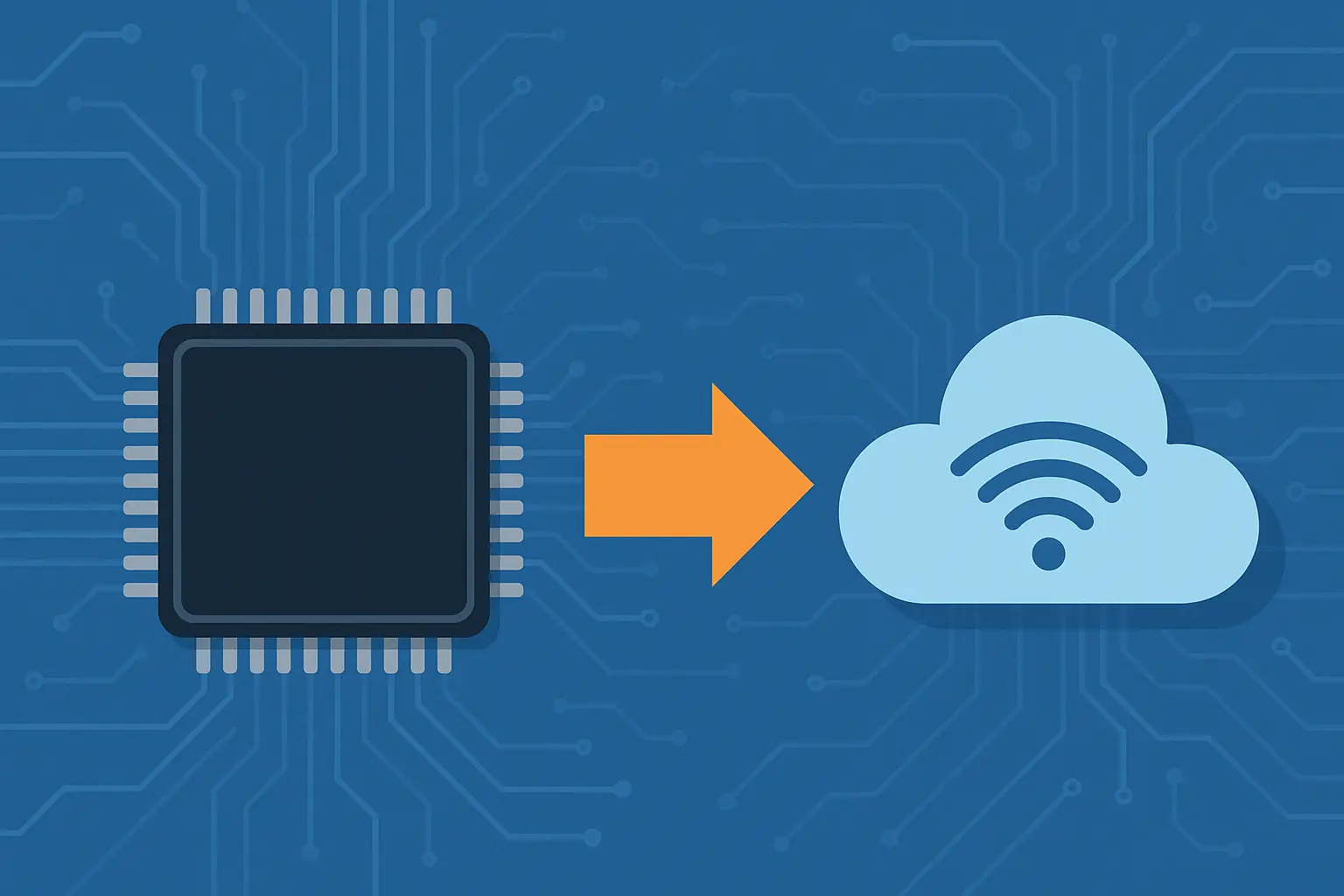
In the world of Industrial IoT (IIoT) bring the calculation close to the source of the data it's not a slogan, but a necessity to reduce latency, power consumption and dependence on connectivity. This is what theEdge Computing, a paradigm that moves analysis and decisions from the cloud to peripheral nodes — often microcontrollers (MCUs) with limited resources but extremely efficient and reliable. Technical literature and industry standards converge on a distributed vision in which value originates directly at the edge.
Why MCU at the edge (and not just MPU or gateway)
The MCUs integrate deterministic CPU, memory, and peripherals in a single chip, ensuring reduced consumption and predictable behavior, fundamental elements for real-time control. In contrast, microprocessors (MPUs) require a complex operating system, more power, and external components. In production lines and industrial devices, microcontrollers remain the optimal choice for intelligent sensors, actuators and condition monitoring modules.
Latency, resilience and energy efficiency
By moving processing “on-device” you dramatically reduce the amount of raw data that needs to be transmitted. Not only this decongests the OT network, but also allows decisions in milliseconds, even in the presence of intermittent connectivity. Furthermore, thanks to the power management mechanisms of modern RTOS (such as the tickless mode of FreeRTOS), the MCU can remain in a low-power state without sacrificing response time.
The role of the RTOS: determinism and integration
Systems like FreeRTOS or Zephyr they offer predictable scheduling, power management and industrial drivers. The tickless approach reduces consumption by maintaining strict timing, while Zephyr's power management framework manages sleep and wake-up at the device and system level. This makes it possible to analyze data locally — filtering, regressions, adaptive thresholds — while maintaining minimal consumption.
Edge AI “small but powerful”: TinyML on Cortex-M
Artificial intelligence at the edge is now a reality thanks to frameworks like TensorFlow Lite for Microcontrollers and optimized libraries CMSIS-NN. 8-bit quantized neural networks can run on MCUs with a few kilobytes of memory, enabling applications like predictive maintenance, anomaly detection and vibration monitoring directly on the sensor.
Industrial connectivity and determinism
Industry requires deterministic and synchronized communications. THE'OPC UA with Pub/Sub extension, combined with Time-Sensitive Networking (TSN), enables many-to-many data exchange over standard Ethernet, ensuring QoS and predictable cycles. MCUs can also integrate legacy protocols such as Modbus, CANopen or EtherCAT, acting as “smart” nodes in the field.
Security by design and upgradeability
Local intelligence increases the attack surface, making it essential hardware and firmware security. Technologies like TrustZone-M And Trusted Firmware-M enable secure domain separation and Secure Boot. Furthermore, Secure Firmware Update (SFU) mechanisms with A/B images and rollback ensure integrity and operational continuity even during updates.
Functional safety and industrial standards
In critical applications, “safety ready” MCUs and certifiable RTOSs accelerate compliance a IEC 61508 (SIL) And ISO 13849 (PL). This involves redundant channels, online diagnostics and fault management procedures integrated into the firmware to ensure functional safety and process reliability.
Edge-to-cloud architecture: a reference model
An edge node on MCU can sample, filter and analyze data via a TinyML model, then publishing only the KPIs or anomalies via OPC UA or Modbus. The cloud remains fundamental to training and fleet management, but the local decision allows immediate reactivity, even in the case of a degraded network.
ROI and practical benefits
The adoption of edge computing on microcontrollers generates measurable benefits: reduced latency, lower power consumption, connectivity independence and increased system availability. Companies integrating local processing into their industrial sensors they improve process quality and reduce operating costs, achieving a tangible and sustainable return on investment.
Insights
If you want to explore the technical details, continue with the key aspects: the role ofRTOS for determinism and low-power, theOn-device AI (TinyML) for classification and anomaly detection on MCU, the industrial connectivity with OPC UA Pub/Sub and TSN networks for predictable cycles, the measurements of embedded security (TrustZone-M, Secure Boot, SFU) and the functional safety for compliance with IEC 61508/ISO 13849. In theedge-to-cloud reference architecture find how to orchestrate these elements to maximize ROI and plant availability.
Bring intelligence to the edge with SiliconLogix
We offer technical consultancy to design and validate edge nodes on microcontrollers: RTOS and power management, TinyML for predictive maintenance, OPC UA/TSN or legacy bus integration, and security strategies (TrustZone-M, Secure Boot, SFU) oriented towards performance, reliability and operating costs.
Contact us for more information