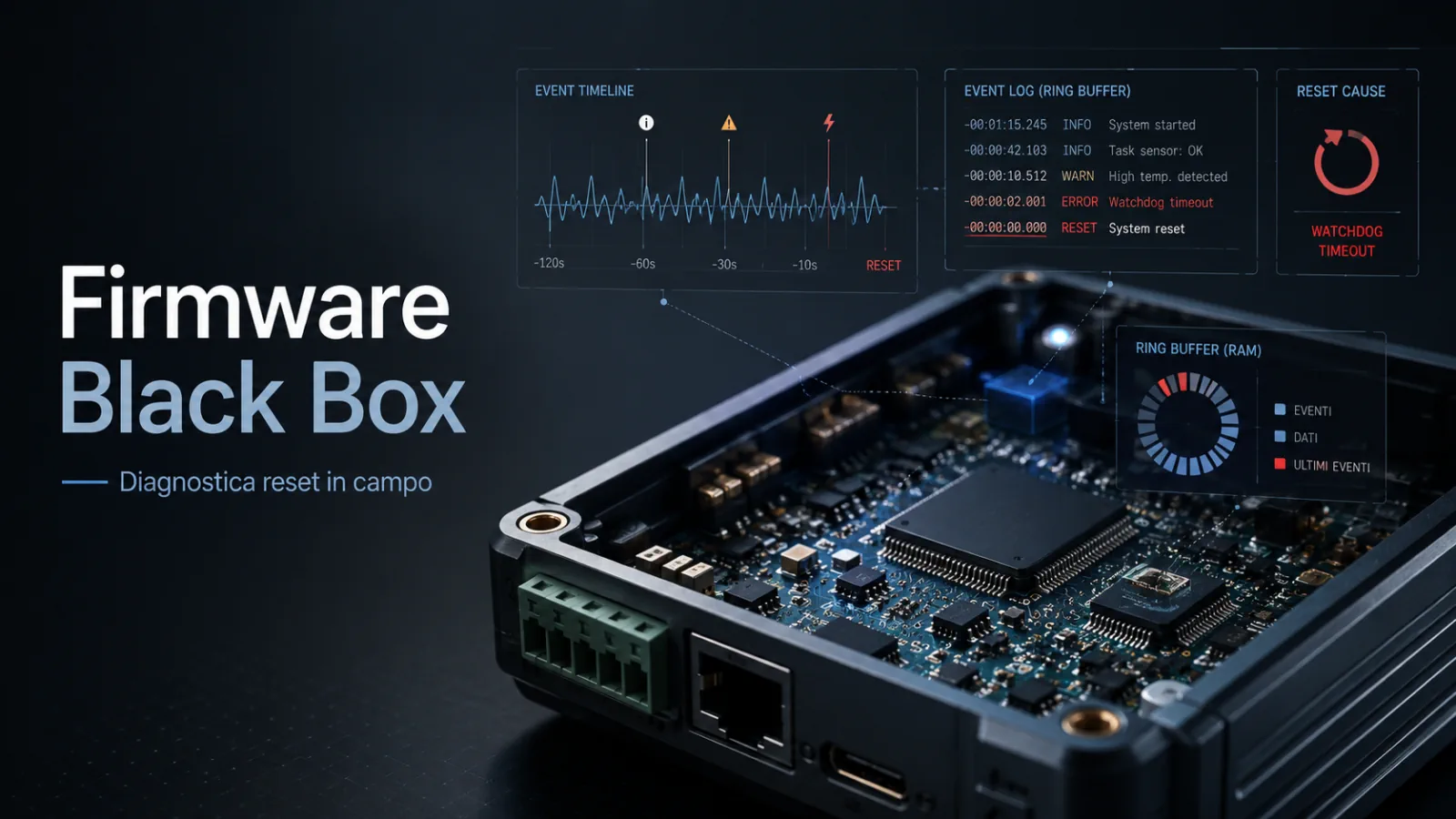
The ESP32 allows you to build reliable IoT nodes that expose REST APIs and a modern Web UI directly from the microcontroller, without cloud and without dedicated apps.
ESP32, Wi‑Fi and Web UI: a technical guide to local IoT
The Internet of Things is not just a constellation of connected gadgets: it is a strategy to bring measurement and control where they are needed, with tight response times and independence from the cloud when necessary. An environmental probe that exposes a web page directly from the microcontroller is a perfect example of "local" IoT: you turn on the device, connect via Wi‑Fi, open the browser and the data appears, without apps, without accounts, without dependencies. In this article I describe in a technical way, but not linked to a single project, how to structure such a system with ESP32, ESP‑IDF in C and a modern Web UI.
Why ESP32
ESP32 combines two 32-bit cores, 2.4GHz Wi‑Fi, and peripherals such as I²C, SPI, and UART into a cost-effective SoC. The presence of integrated Wi‑Fi avoids external modules, while the ESP‑IDF toolchain allows you to work in C with direct control over tasks, heap and drivers. This balance between power and simplicity is ideal for transforming an inexpensive sensor into an intelligent node that measures, processes, publishes APIs and presents a graphical interface that can be used from any device.
From sensor to browser
The flow starts from a measurement routine - for example a temperature and humidity sensor on the I²C bus - which reads at regular intervals and calculates any derived quantities, such as dew point or comfort indices. The most recent samples are kept in memory in a circular buffer; the latter is exposed by a lightweight endpoint, while the time series allows the interface to draw fluid graphs. Choosing a ring buffer avoids unpredictable allocations and makes the system responsive even on MCUs with limited RAM.
Network and addressability
A device can function as an Access Point by creating its own local network, or as a Station by connecting to the user's router; in some cases it is better to maintain both methods. The AP is convenient for first startup and offline scenarios; the STA offers NTP, LAN integration and server-side communications. To make access intuitive it is useful to publish an mDNS name — for example slx.local — like this the user can open the page without remembering the IP address. When choosing the AP address, it is best to avoid subnets common to the network home, favoring spaces like 192.168.50.1 or 10.10.10.1 to reduce routing collisions on clients.
A web server on board
Serving a page from ESP32 means providing static assets and a few JSON APIs. With ESP‑IDF you can embed HTML into the firmware during build e return it with an HTTP server handler. This solution eliminates the need for an onboard filesystem when the UI is composed of one or two files and, when combined with gzip compression, it reduces bandwidth and loading times. The most useful endpoints are typically a /api with the last sample and a /history with the compact time series; for diagnostics you can add a /info that describes the device, firmware version and hostname.
Data and time model
Measurement data travels in JSON with explicit fields and clear units. For timestamps, if the device is in STA and has synchronized the clock via SNTP it is natural to send the epoch in milliseconds; in pure AP mode, where Internet access may be lacking, it is equally valid to send uptime and leave conversion into relative labels at the interface. This strategy makes the UI independent of the presence of absolute time.
The user interface
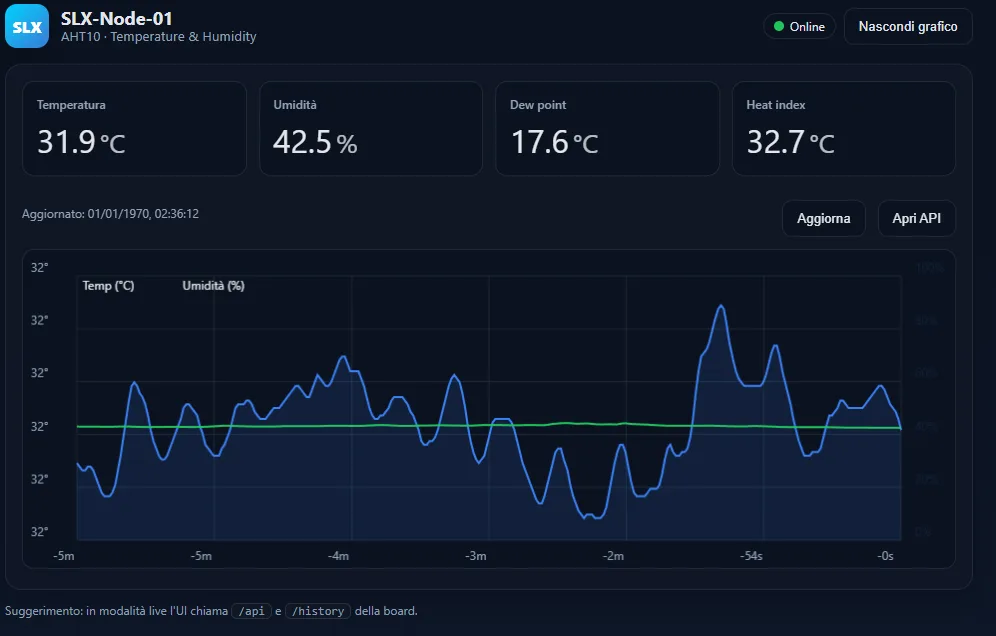
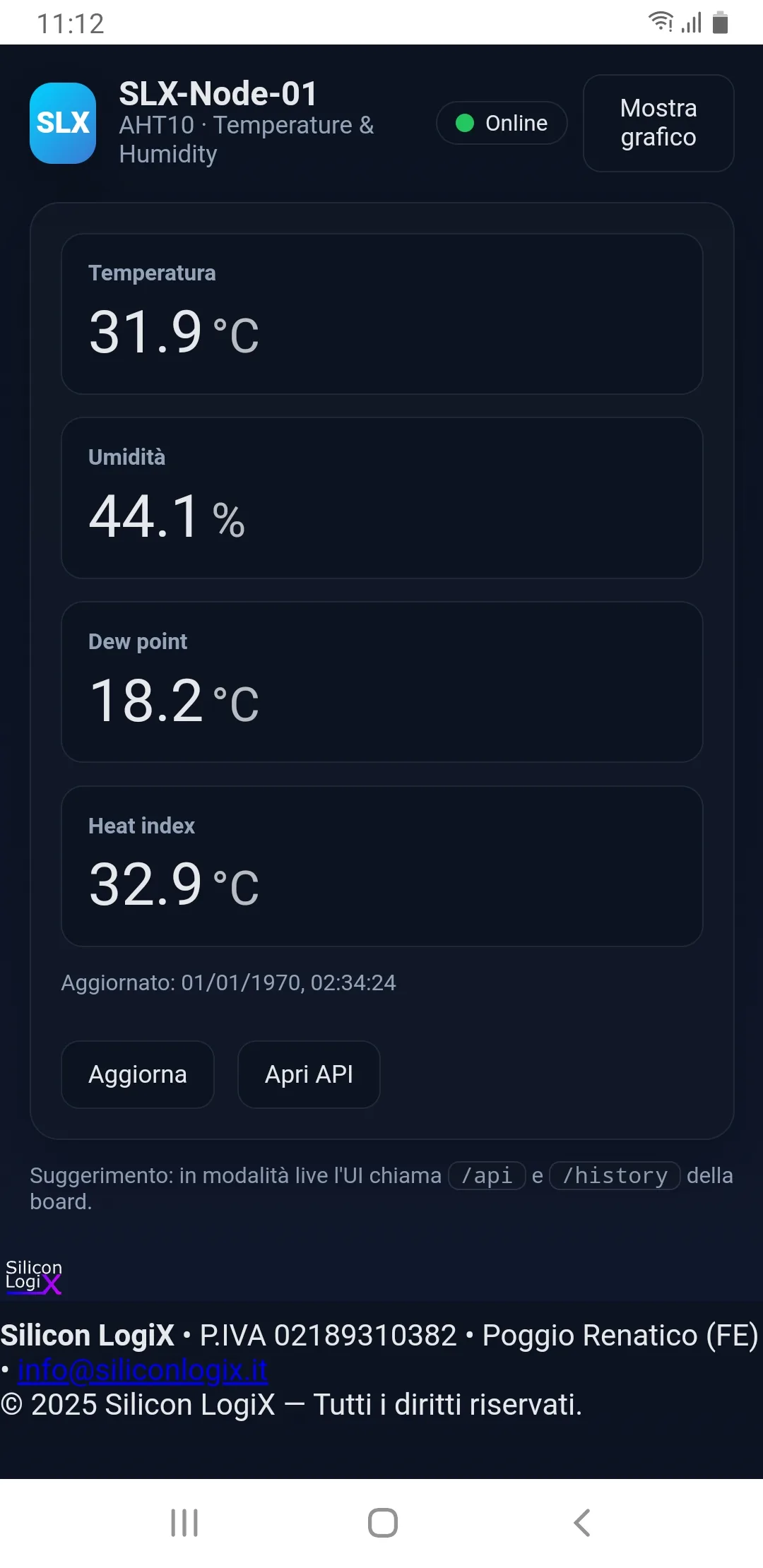
A single HTML page with a modern, responsive and lightweight style can show the logo, the name of the device, the type of sensor and four boxes for the main quantities. A Canvas graphic — without external libraries — makes the system streamlined and easily portable; with light smoothing and a contextual tooltip the experience is pleasant too on smartphones. On the network side, a status indicator is useful, while in the footer it is natural to host the brand and company references. Since everything is served by the device, there are no CORS issues and the user sees the data in real time.
Tasks, memory and reliability
Separating tasks into distinct tasks simplifies stability: a measurement routine does not have to block HTTP, and API responses do not have to depend on the update of the graph. NVS initialization must be made robust with full page or version change case management, while Wi‑Fi startup deserves a stack of adequate size to avoid overflow during setup. To increase resilience, above all When developing via USB, it is useful to reduce the transmit power and enable power saving modes, so as to avoid brownouts or serial disconnection when the AP starts.
Reasoned security
In a local context authentication may be minimal, but it is worth setting WPA2 on the AP when the data is non-trivial and providing limits of frequency to the API to avoid inadvertent abuse by browsers. In a production environment, with devices in STA, the use of TLS requires evaluation be careful of RAM and latency costs: the ESP32 supports it, but it is better to plan it together with the over-the-air update policy and the certificate management.
Provisioning and updates
The transition from AP to STA can be guided by a provisioning page with captive portal: the user connects to the device's AP, chooses the home network, enters the password and the device saves the credentials in NVS. For the firmware lifecycle, it is convenient to adopt dual-slot partitions and an HTTP endpoint dedicated to updates, with version verification in the information endpoint; in this way it is possible to distribute improvements to the interface and drivers without touching the hardware in the field.
IoT, use cases and potential with ESP32
Local IoT enables scenarios ranging from home automation to light industry. A node that measures temperature and humidity becomes the basis for climate regulation in small systems, for the protection of archives and museums or for the surveillance of electrical panels and technical rooms. With the same paradigm, changing sensor, you can monitor air quality, brightness, vibrations or energy consumed; you can generate alerts in LAN, connect to existing systems via MQTT or export metrics to department dashboards. ESP32 is particularly suitable because it combines reliable connectivity, sufficient resources for a pleasant UI and a mature development platform. The ability to serve everything locally simplifies privacy, reduces recurring costs and improves latency.
Conclusion
An ESP32, an inexpensive sensor and a well-designed web page are enough to shape a professional IoT probe. Choosing to stay close to the hardware with ESP‑IDF, serve a lightweight UI, and expose local APIs produces systems that understand, maintain, and grow. It is a solid foundation for experimenting today and industrializing tomorrow, bringing together user experience, security and reliability.
Do you have a project to carry out?
Silicon LogiX designs end-to-end IoT solutions: from low-level firmware on ESP32 to Web UI, up to mobile apps and cloud backends, taking care of Wi-Fi/BLE connectivity, security and scalability — contact us for consultancy or a tailor-made project.
Contact meReliable local setup
ESP32.local: an mDNS checklist and troubleshooting guide
The esp32.local hostname makes a local web UI easier to reach, but it does not replace network validation or a recovery path for the user.
- Confirm the network mode. Separate the device access-point case from joining an existing Wi-Fi network, then check IP address, gateway and the actual connection state.
- Start mDNS after the network is ready. The service should start after the interface has a valid address and use a stable hostname that does not conflict with another device.
- Check multicast and client isolation. Guest networks, VLANs and access points with client isolation can block the mDNS traffic required to resolve .local names.
- Test the real client. Test the browsers and operating systems customers actually use, not only the development computer, and verify behavior on the target network.
- Provide a readable fallback. Showing the local IP address, network status or a provisioning path keeps esp32.local from becoming the only access and diagnostic route.
Frequently asked questions
Why does esp32.local not open?
First confirm that the device joined the expected network, received an IP address and started mDNS. Guest Wi-Fi, VLANs and client isolation can prevent .local name resolution.
Does esp32.local work when the ESP32 runs an access point?
It can work when the client and access point handle mDNS correctly, but first-time setup should also expose a local IP address or a clear provisioning flow.
Does esp32.local work on Android, iPhone and Windows?
Support depends on the device resolver and network. Test the actual client platforms the product supports instead of assuming development-machine behavior applies everywhere.
Should a product rely only on esp32.local?
No. A .local hostname is a useful LAN convenience, but a reliable product also exposes network status, an IP address or a recovery flow when mDNS is unavailable.
Can esp32.local be reached from another VLAN or from the Internet?
mDNS is normally limited to the local network. Different subnets need explicit network configuration or a dedicated mechanism; it is not an Internet remote-access method.