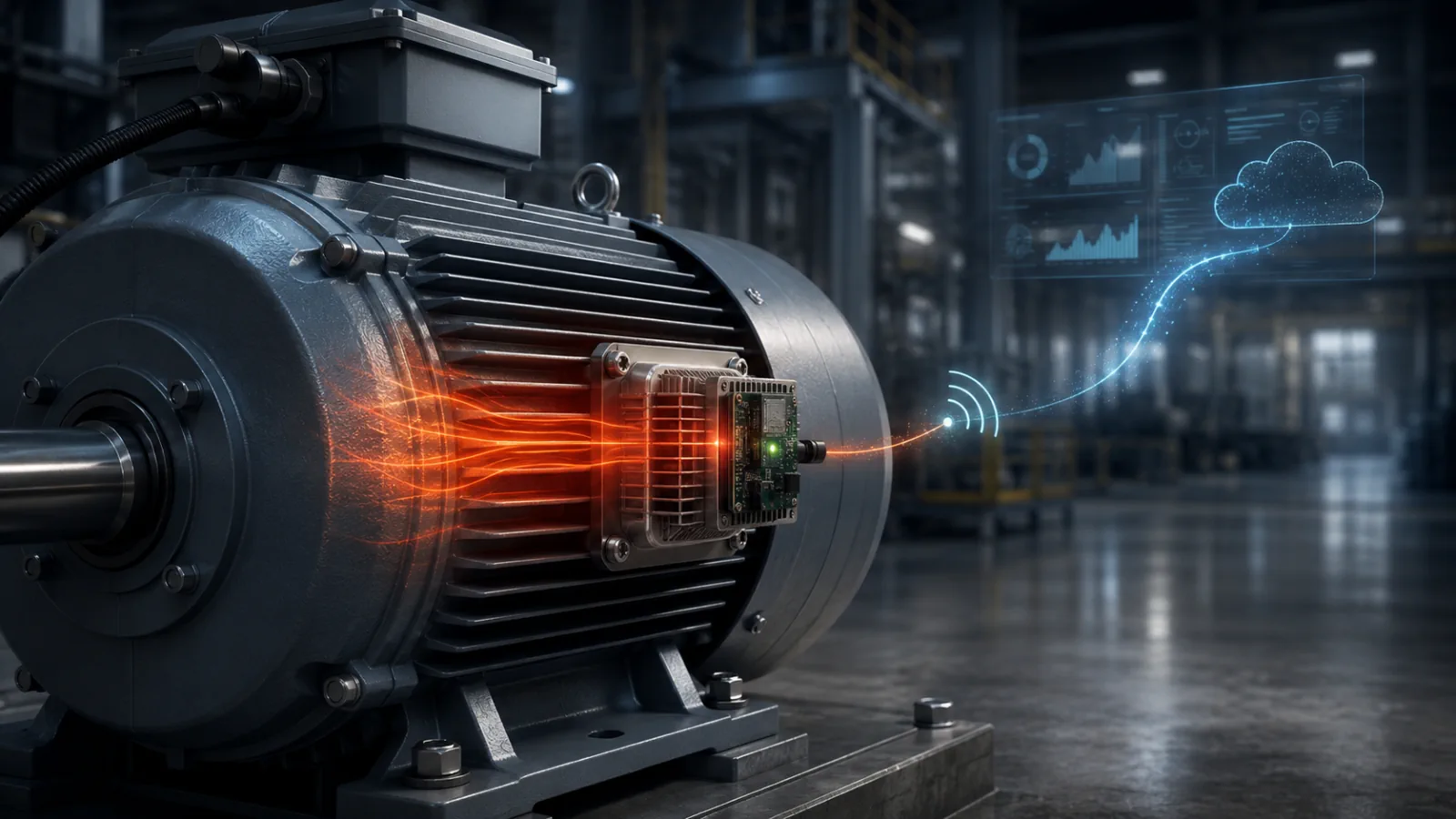
A high-temperature SCADA alarm on a motor is not yet a diagnosis. A technician must determine whether it is a temporary spike or an emerging trend, check for unusual vibration or current draw, reconstruct recent maintenance work, and find the correct procedure for that specific machine. In many companies, the data already exists, but it is scattered across SCADA systems, PLCs, IoT gateways, PDF manuals, and maintenance records. The problem is not a lack of information. It is a lack of operational context.
This is where AI for industrial alarms can become a practical tool. It should not replace the maintenance technician or autonomously control the machine. Its role is to collect relevant data, connect it to technical documentation, and return a first diagnosis that people can verify. The goal is to reduce the time between an alarm and a useful decision while making interventions, work orders, and procedures more consistent.
The starting point for this article is an NVIDIA technical article on AI agents for industrial alarm management, published on July 7, 2026. The proposed architecture receives an alarm together with its sensor data, retrieves history and procedures, runs targeted checks, and returns a structured evidence package containing an observation, a root-cause hypothesis, a remedy, and a recommended action. It is not a universal, ready-made solution for every factory, but it highlights a concrete direction: alarms can become an entry point into the operational data a company already owns.
An alarm is not a diagnosis
In a real plant, an error code or a threshold violation is only the beginning. Before deciding whether an intervention is actually required, staff must check whether the same event has occurred before, whether the value is unusual for the current production cycle, whether other sensors confirm the issue, and which procedure applies to that exact machine revision.
When answering these questions means opening several dashboards, searching through PDF documents, reviewing old tickets, and relying on the memory of the people who know the plant, even a simple alarm can become time-consuming. The risk is not limited to downtime. Teams may make decisions from incomplete information, while repeated events gradually become background noise.
An AI-based support system can help during triage. It can collect the event, inspect the available context, and prepare a useful technical brief. Instead of merely displaying “high temperature,” it can show how long the value has remained above the threshold, which related signals have changed, whether similar cases exist in the maintenance history, and which procedure deserves attention.
AI agents for industrial alarm triage
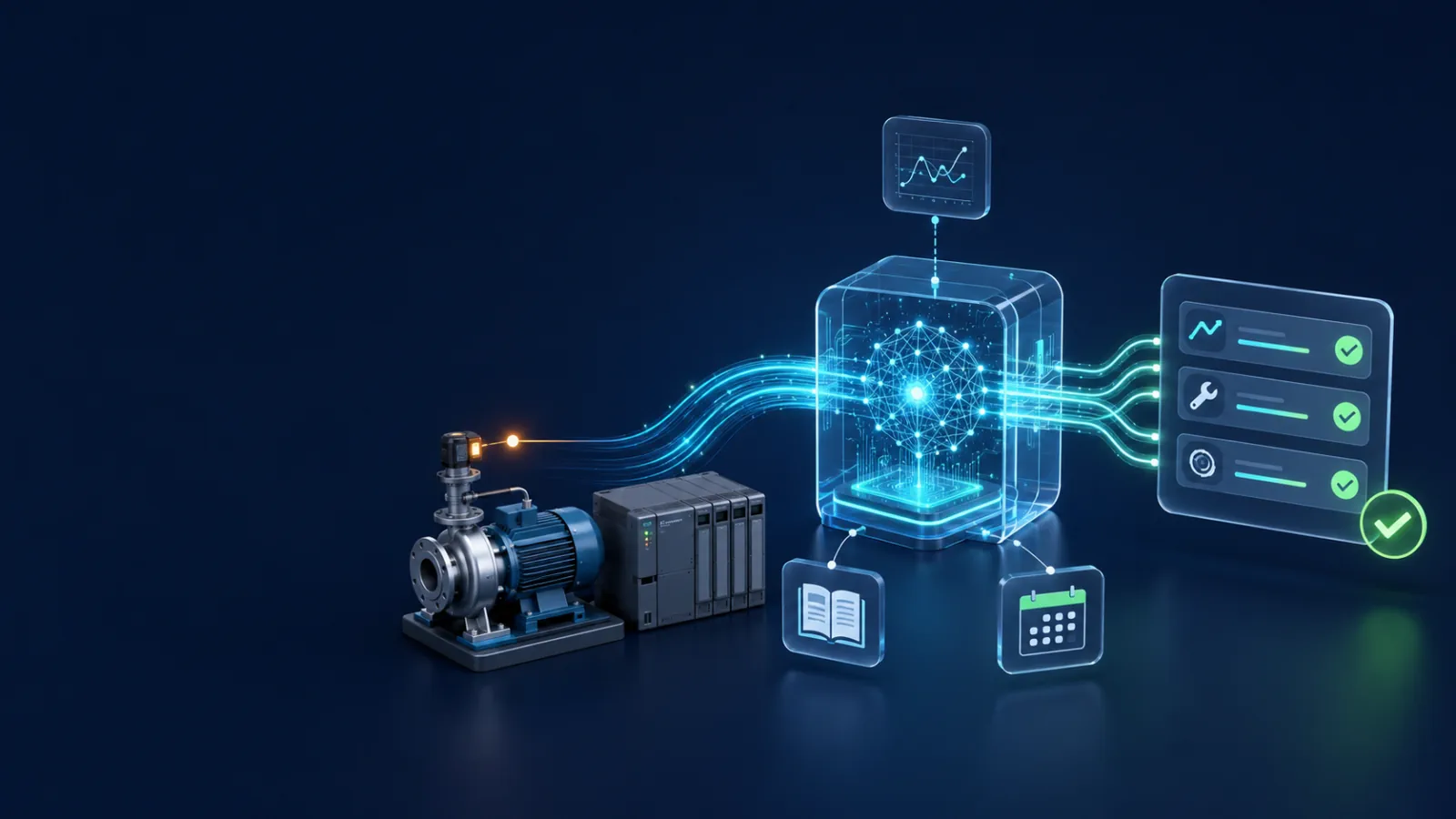
The idea behind an AI agent for industrial alarms is straightforward: every important event triggers a process that gathers, analyzes, and summarizes relevant information. The input is not a generic question typed into a chatbot. It is an operational payload containing an alarm code, timestamp, machine identifier, relevant sensor readings, and asset metadata.
The system can then consult different sources. SCADA alarms and PLC data help reconstruct the event sequence. Temperature, vibration, current, or pressure sensors help determine whether a real trend exists. Manuals, diagrams, and service procedures describe which checks should be performed. Maintenance records show whether the company has already solved a similar case and which intervention worked.
The output should not be vague prose. It should be a clear evidence package: what happened, which data supports the observation, which cause is plausible, which documentation was consulted, and which action should be evaluated. The technician remains in control of the decision without having to rebuild the entire context from scratch for every alarm.
A practical example: a pump with abnormal temperature
Consider a pump that raises a high-temperature alarm. A traditional dashboard may show the code, timestamp, and current value. An assisted diagnosis can surface much more useful evidence.
The system may detect that the temperature has remained above the threshold for eighteen minutes and has increased over three production cycles. It can then verify that motor current is stable while vibration on the coupling-side bearing has risen compared with the previous month's baseline. It can search earlier interventions on pumps from the same family and find cases related to misalignment or insufficient lubrication. Finally, it can retrieve the checks and reference values from the manual for the installed revision.
The resulting recommendation can be concrete: inspect the coupling and lubrication during the next available maintenance window, monitor the trend for a defined number of cycles, and open a work order if the value continues to rise. The AI should not command the pump, modify PLC parameters, or autonomously decide to stop the line. It should turn scattered data into an operational brief, supported by evidence that the technician can verify and correct.
Where the data comes from: SCADA, PLCs, gateways, and documents
A useful project does not necessarily require replacing the existing automation stack. In most cases, it starts from systems that are already in place: PLC signals acquired through Modbus, OPC UA, EtherNet/IP, or documented proprietary protocols; alarms and trends available in the SCADA system; data collected by IoT gateways or additional sensors; and manuals, service procedures, PDF reports, tickets, and maintenance history.
Normalization is the critical step. An alarm code must be linked to a machine, line, component, revision, relevant sensors, and the correct procedure. Without this foundation, AI can produce plausible but unreliable text. With an organized data model, it can accelerate the same information retrieval process that technical staff already perform every day.
This is why a serious project does not start with the AI model. It starts with the asset map, the data that is actually available, the quality of the historical records, and the operational meaning of each event. Only then does it make sense to choose between rules, statistical analysis, anomaly detection, document retrieval, or a more advanced AI agent.
Edge, cloud, or a hybrid architecture?
There is no single answer for every plant. The choice depends on data volume, required response time, available connectivity, and the type of analysis. A local gateway or industrial PC can collect, filter, and correlate field signals close to the machine. A central service can compare data across several sites, index technical documentation, and provide shared operational dashboards.
A hybrid architecture is often the most practical option. Critical data and logic remain close to the plant, while heavier analysis or document-retrieval services run centrally. A company with a few machines and limited historical data may begin with dashboards, rules, and document search. A production site with many events and enough data can later add anomaly-detection models and more structured AI services.
The architecture should follow the real process constraints, not the “AI” label. The objective is not to add technology everywhere. It is to make a decision that currently depends on time and distributed knowledge faster and more reliable.
How to start without creating an endless project
The right way to test this technology is not to build a “factory brain” on day one. Start with a narrow, measurable use case that is valuable to the people doing the work. One family of pumps, compressors, ovens, or motors with recurring alarms is an excellent starting point.
A proof of concept can focus on three to five high-priority error codes. For each event, connect process data, intervention history, and technical documentation. Maintenance technicians should then validate the system's responses. A spectacular demo is not the objective. The relevant questions are whether the suggestion is useful, whether the supporting data is correct, and whether the system reduces the time needed to reach a first intervention hypothesis.
At the end of the test, the company can measure average triage time, the percentage of events with correct technical context, false suggestions, source quality, and the cases in which the system avoided a manual search. These metrics show whether the project should be extended to other lines or whether the data, procedures, and integrations must be improved first.
What an industrial AI agent should not do
Defining boundaries is the most important part of this kind of project. A useful agent should suggest, explain, and connect information. It should not become an opaque control layer between the operator and the machine.
Control and safety logic must remain separate, deterministic, and managed by PLCs, certified systems, and company procedures. AI can support analysis and propose a sequence of checks, but approving an intervention, opening a work order, or changing parameters must remain under human control.
This distinction makes the project more credible and easier to adopt. AI is not presented as a replacement for experience, but as a tool that makes experience available when it is needed, including when the technician who knows a machine best is not present.
How Silicon LogiX can support industrial teams
Silicon LogiX develops systems that connect firmware, industrial connectivity, Linux gateways, data collection, operational dashboards, and on-device or on-premises AI. The objective is to turn alarms, logs, and technical documents into a practical tool for the people who manage machines and plants.
The work can begin with a single asset or an existing line. We evaluate protocols, available data, historical-data quality, technical procedures, and plant constraints. This analysis can lead to a proof of concept that combines PLC and gateway data collection, ticket or report integration, an operational dashboard, and clear criteria for measuring the value of the solution.
There is no need to begin with a large platform. In many cases, the first useful outcome is an assisted, readable, and traceable diagnosis that helps staff identify the likely cause of an alarm sooner and follow a more consistent procedure. If the test delivers value, the platform can evolve toward predictive maintenance, multi-site monitoring, anomaly classification, and integration with existing business processes.
Conclusion
Industrial alarms are already a valuable source of information, but they often remain isolated events inside separate systems. Connecting SCADA, sensor data, technical documentation, and maintenance history turns them into a starting point for faster diagnoses and better-documented decisions.
AI becomes valuable when it is applied to a concrete problem: reducing the time required to understand what is happening, giving technicians the right context, and making years of company knowledge easier to reuse. The first step is not purchasing a complex infrastructure. It is choosing a real use case, measuring it, and building a reliable technical foundation.
Do your alarms, logs, and technical documents work together today?
Silicon LogiX can evaluate a proof of concept on an existing asset or production line: PLC and gateway data collection, integration with historical records and documentation, an operational dashboard, and measurable criteria for determining whether AI delivers real value.
Evaluate an industrial proof of concept