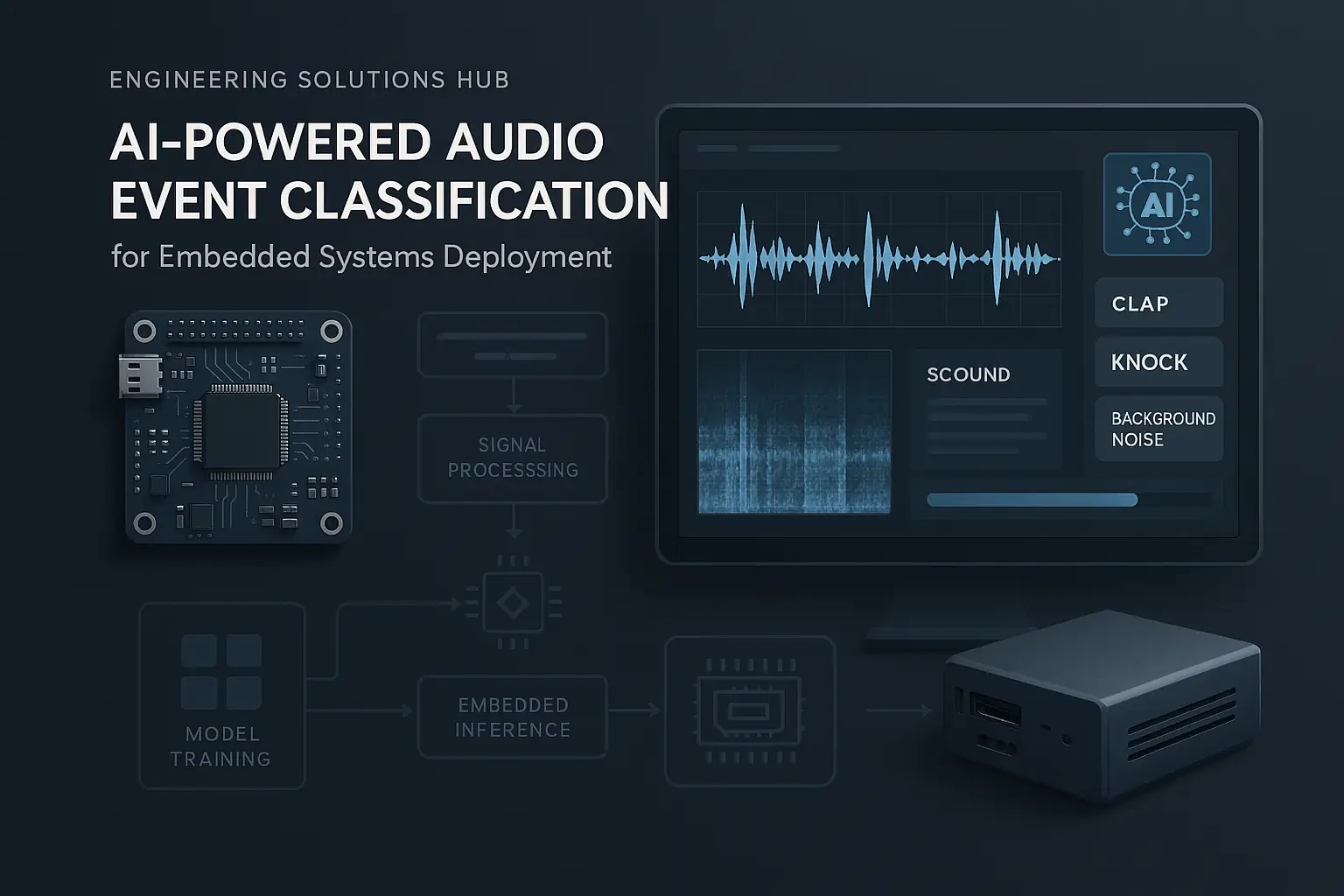
Sampling, noise and time windows affect what a model can recognise. Work covers acquisition, preprocessing and feature selection before classification. Tests separate recordings and capture conditions so near-identical segments do not appear in both training and evaluation.
Activities and verification
Define sampling, filters, windows and spectral or temporal features.
Compare classes, background noise and unknown events.
Measure recognition delay, memory and load on the target system.
Initial decisions and integration
I agree events to recognise, sensor placement, capture frequency and time available for decisions. I can contribute to signal processing or classification within the client’s stack, documenting formats, preprocessing and the connection to application logic.
A verification example
Recordings and capture conditions are separated between development and testing, including noise and signals outside the expected classes. Delay is measured across the complete chain, from the acquisition window to the result, beyond model execution alone.
Deliverables and acceptance criteria
Processing chain, model, implementation and report using separate data. The catalogue’s bare-metal audio classifier illustrates a possible path to C inference without an operating system.
Where to start
Provide representative recordings, sample rate, events to distinguish and device constraints.
Can classification run on the device?
This is assessed on the target with the intended signal, considering acquisition, preprocessing, available memory and computation. The model and runtime follow those constraints.