An RTOS needs explicit responsibility boundaries, beyond simply creating tasks. Events, periodic workloads, priorities and critical sections are analysed so communication, interfaces and acquisition do not block one another. Decisions are verified against the actual workload and target platform.
Activities and verification
Define tasks, queues, notifications, mutexes and ownership of shared data.
Analyse stack, heap, watchdogs, priority inversion and error paths.
Test latency, jitter and load during heavy traffic, timeouts and peripheral faults.
Initial decisions and integration
I gather deadlines, event rates, functional priorities and concurrent workloads. Kernel choices follow the hardware, existing code and team processes. I also examine how interrupts, drivers and libraries share data and resources: timing depends on the complete chain.
A verification example
A useful scenario combines periodic acquisition, communication traffic and a slow peripheral. Delays, stack usage, blocking and watchdog behaviour are observed under defined conditions. Bench measurements support verification but do not alone prove behaviour in every possible state.
Deliverables and acceptance criteria
Task architecture, kernel configuration, source code and measurement reports. Deadlines and test workloads are agreed explicitly: using an RTOS alone does not demonstrate real-time compliance.
Where to start
Bring the hardware platform, toolchain, event rates and maximum acceptable response times for critical functions.
Does an RTOS automatically make a system real-time?
Deadlines require appropriate architecture, priorities and execution paths, together with checks against expected workloads. The kernel is one component of the system.
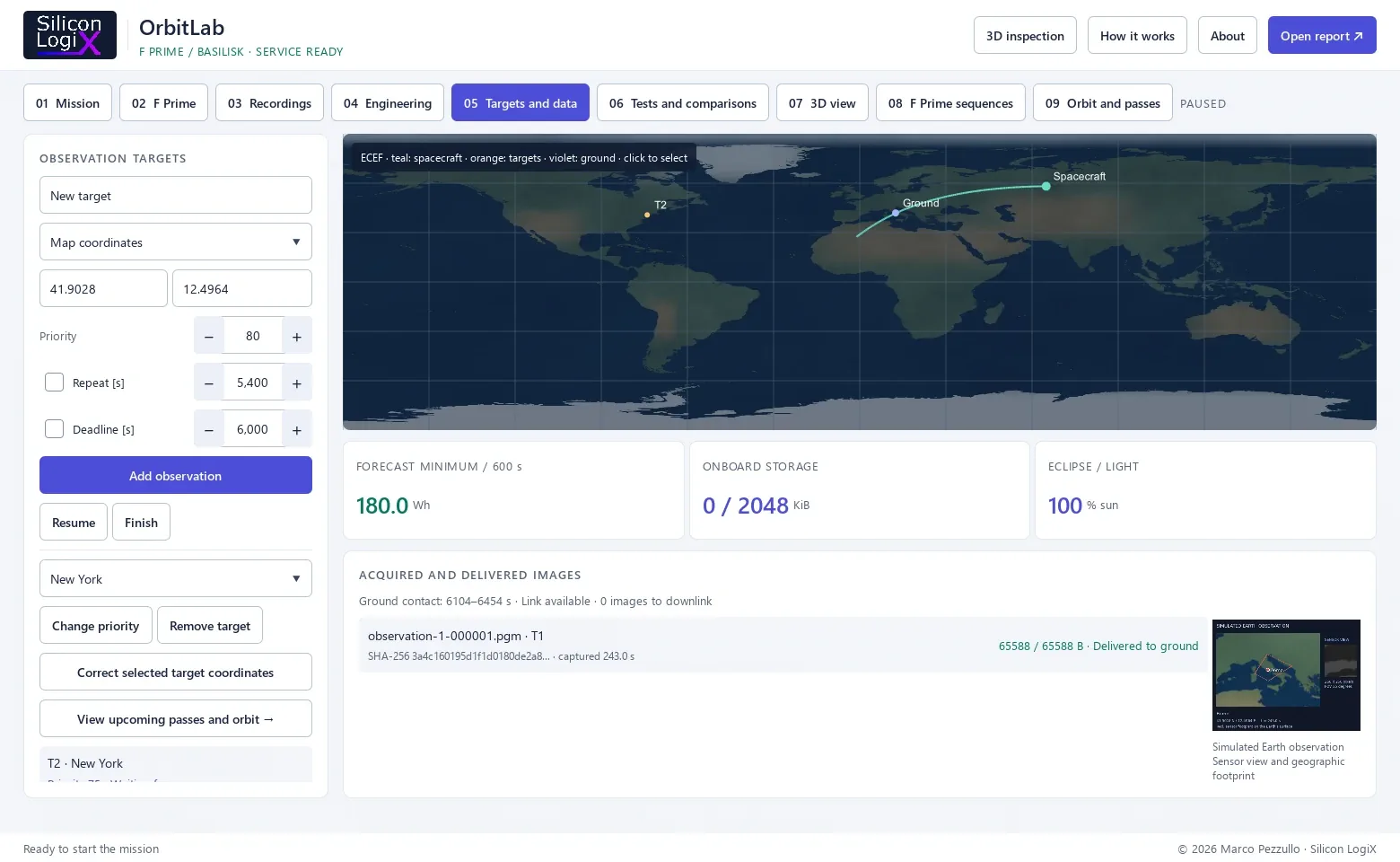
SLX OrbitLab integrates F Prime, Basilisk, a proprietary C++ core and a Qt console for satellite mission planning, energy and data management, and embedded firmware development with RTEMS and Renode.
A practical comparison of FreeRTOS, Zephyr and Eclipse ThreadX for embedded products: footprint, governance, connectivity, security and long-term maintenance.